AI in Predictive Maintenance: A Second Verse, Supporting the First
Scaling up may require AI to make sense of all the data
Published April 22, 2026

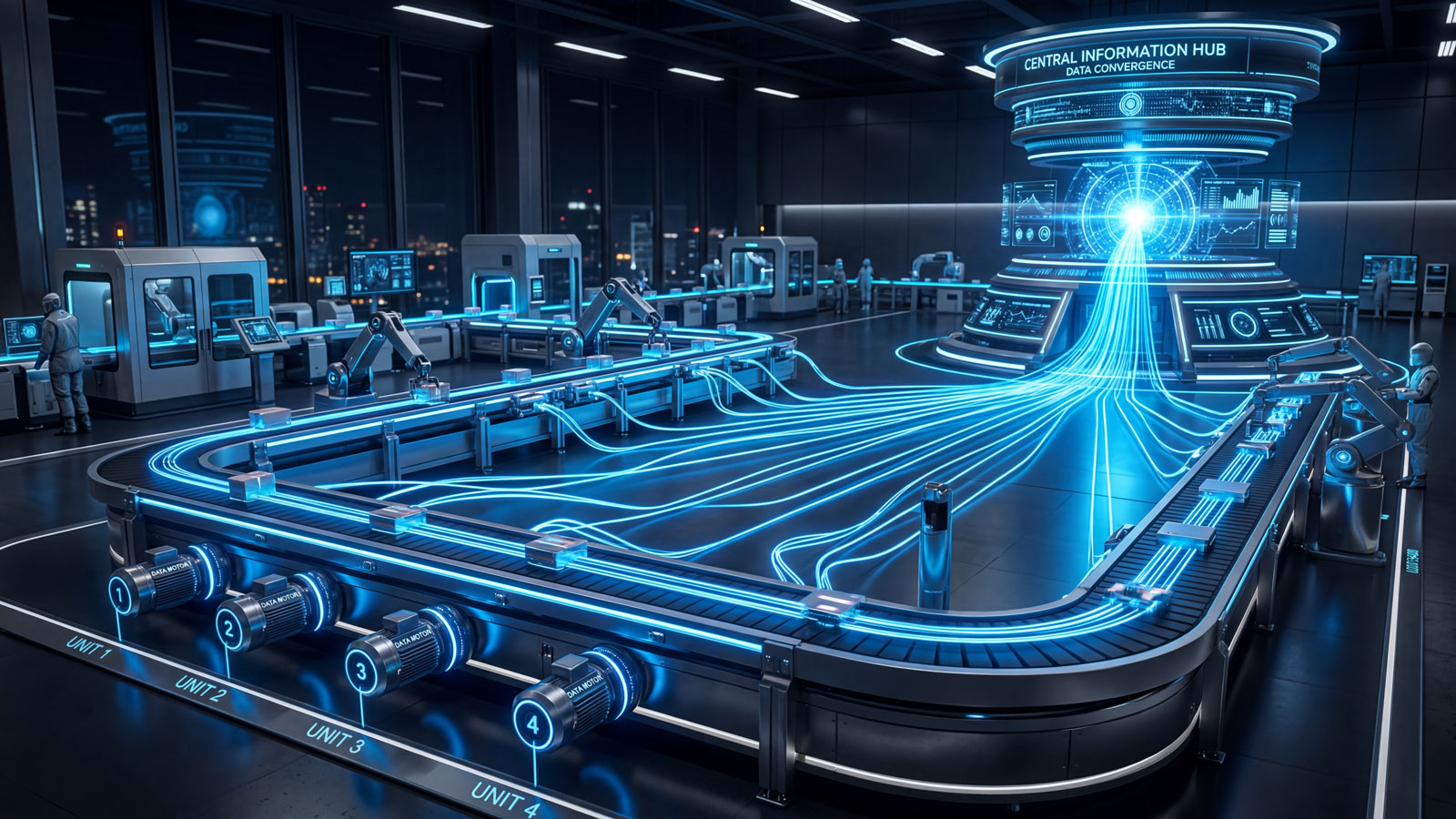
Today, we're able to capture a lot of data from our machines. The question is, what do we do with it, and is AI the answer?
For the past few years, AI has been the big new buzzword. Countless big tech hype men have gotten on stage and made a lot of very lofty promises about how AI will completely transform all our lives. This new tech is the next industrial revolution. It will allow you to manage your factory lines and predict tomorrow’s needs with unprecedented precision. It will fundamentally change how we do business from now on. And you don’t want to be left behind!
I can’t help but hear all the hype and feel a sense of deja vu. Haven’t we all been here before?
For over a decade, the Industrial Internet of Things (IIoT) has been in the headlines with identical promises. This new tech is the next industrial revolution. It will allow you to manage your factory lines and predict tomorrow’s needs with unprecedented precision. It will fundamentally change how we do business from now on. And, of course, you don’t want to be left behind.
It is striking how similar both of these technologies feel, from their hype cycles to their proposed benefits to their customer bases. Even many of the use cases are the same: managing operations, building smart factories, and predictive maintenance.
Predictive maintenance is, in fact, a perfect example to illustrate just how much these two technologies overlap.
Predictive Maintenance: The Basics
One of IIoT’s most prominent use cases is predictive maintenance, which can operate at a few different levels.
At the micro level, you can imagine a single motor with a single sensor. When they’re installed together, that sensor can track a motor’s performance for the entirety of its life. The first few years, when the motor is operating properly, the sensor can essentially take a “control sample” of how the motor is supposed to work, tracking everything from torque to motor vibration.
Then, as the motor ages and inevitably begins to show signs of wear, its performance will start to change. The sensor can pick up these fluctuations, compare them against that control sample, and, once they grow severe enough, alert you that the motor is approaching its end of life.
By doing all of this, you have advance warning to fix potential issues such as that failing motor. Rather than scrambling to fix a motor when it dies and your entire factory line grinds to a halt, this advance warning buys you time to handle the issue in a controlled manner. With that foreknowledge, you can halt the affected manufacturing line at a more convenient moment of your choosing to replace the motor.
Now hook up a thousand motors across your entire factory floor to a thousand sensors. At this scale, you can start detecting trends. Why is a particular class of motor repeatedly failing three years short of its expected lifetime? Why is the factory consistently not operating at 3PM on a Wednesday? IIoT solutions give you the ability to notice and start investigating these trends. Now, you can not only predict when a motor will fail, but you have the data to tell you when the optimum time to replace it is and how long that motor is statistically going to last.
As you zoom the scope out, predictive maintenance gives you larger and larger datasets until you are studying company-wide trends. But the larger these data sets grow, the more information you have to sift through to make good, competent decisions based on all that data.
If you aren’t a giant enterprise-scale business, you aren’t likely to have the funds to hire someone whose entire job is to study and present all this data. IIoT companies do often provide software meant to help manage this firehose of information and have worked hard to provide solutions that scale with your company’s capabilities. But AI, the current tech du jour, is a promising solution almost tailor-made for the task.
Where AI Comes In
In 2023, Richard Blake, digital product manager of Shell Projects & Technology, gave a presentation detailing the company’s journey with C3 AI to track millions of components across their business. It is one of the highest profile case studies on the topic of predictive maintenance out there. If you’re not familiar with it, the full presentation is worth a listen, but here’s the short version.
Back in 2017, Shell committed to the idea of establishing predictive maintenance tools tracking the state of all valves company-wide. The challenge, however, was that those components numbered in the millions. Even if you did build an IIoT apparatus to track all those components, you would need an army of technicians to even skim the flood of data coming in.
Faced with this scaling challenge, Shell turned towards automation, partnered up with C3 AI, and the two companies spent years working hand in hand to develop a bespoke AI solution to track these components. After all those years of work, they successfully scaled their solution to cover the full company. The AI monitors the millions of components, then when it notices one failing, flags the component for human review. Through this method, Shell has successfully averted major outages that would have cost the company tens of thousands of dollars or more.
This is what AI brings to the table for predictive maintenance. One of AI’s biggest strengths is its ability to manage large data sets and recognize patterns within them. In manufacturing, there is an increasing need for a tool that can do exactly that.
You can see examples of this dynamic across the industry. Siemens told a nearly identical story in a case study last year with milk processor Sachsenmilch. An IBM report surveying over 2,000 manufacturing executives found a similar story playing out repeatedly. IIoT has unlocked the ability to generate more data than ever, but we’re still looking for ways to organize that data and make informed decisions based on it.

We’re still a long way from the world manufacturers imagined when they first announced the birth of Industry 4.0. A growing number of IIoT providers, however, think AI is the next step to realize it.
How AI and IIoT Fit Together
It’s hard to deny how well these two technologies feed into each other. AI is a technology with an unparalleled ability to quickly process data that is only as effective as its input, and the Internet of Things is a solution that offers unparalleled amounts of data, but its output will only ever be as valuable as your ability to process it.
Both technologies also have similar strengths. They both work best at the enterprise scale — the bigger the operation, the better a solution they become. They both benefit from having clearly defined parameters to work inside of. Like any other software, both work well in data-driven environments dominated by if/then scenarios where behavior is consistent, reproducible, and predictable.
It’s also a much harder sell outside of those applications. One thing you might notice about Shell’s case study: It did the seemingly impossible — after half a decade of development with multiple dedicated teams of specialists working on that exact issue. If you’re not an enterprise corporation at Shell’s scale, that’s a hefty bill.
It is important to remember, however, that AI is a relatively young technology. With most technology, you can typically expect to see applications become more accessible as the tech matures. The question remains: If you don’t have enterprise levels of money and manpower, how do you incorporate AI?
A Roadmap for Implementing AI
You might remember an infamous MIT report from last year that found that 95% of AI implementation attempts were failing. There are a lot of caveats and asterixes attached to that statistic, but once you get past the big headline, most of the report itself is actually about the 5% that were succeeding and what they’re doing differently. A lot of the wisdom in that report overlaps with what companies like Shell and Siemens have discovered.
First, as with all fundamental changes in your business, implementation must start with a problem, not a solution. AI is in a gold rush period where just about every software-related company is looking for ways to use this new technology to snag a new slice of their market, but this is working from the wrong direction.
Instead, you need to be deliberate about starting from a specific problem or bottleneck your company is experiencing, then investigating how you can fix that problem. In some cases, such as predictive maintenance, AI can be the solution, but understand why you’re using it before you make the leap. Do not, under any circumstances, decide to implement AI because it’s popular, then go looking for an application to use it on.
Second, work with an established specialist in the AI space rather than trying to go it alone. Even Shell, with all their manpower, ultimately found it easiest to work with an external partner to scale their monitoring solution company-wide. Like a lot of new, complicated technologies, you won’t be able to learn how to implement AI in a day, and these specialists’ entire job is to help you get up and running quickly and efficiently.
If nothing else, you can fall back on 15 years of past experience, because we’ve been here before. You already have a roadmap on how (or how not) to implement AI, because you already made these decisions once when IIoT was turning heads.
If you jumped on as an early adopter of the Industry of Things and never looked back, you will probably also reap the same benefits adding AI to your tech stack. If you shrugged and just kept working as you always do and the sky didn’t immediately fall, it probably won’t if you do that again.
However you choose to handle the current moment, just remember to be deliberate about that choice.