Automating Quality Control
At Musashi AI, Vision and AI Combine for Real-Time Inspection of Complex Parts
Published August 12, 2026

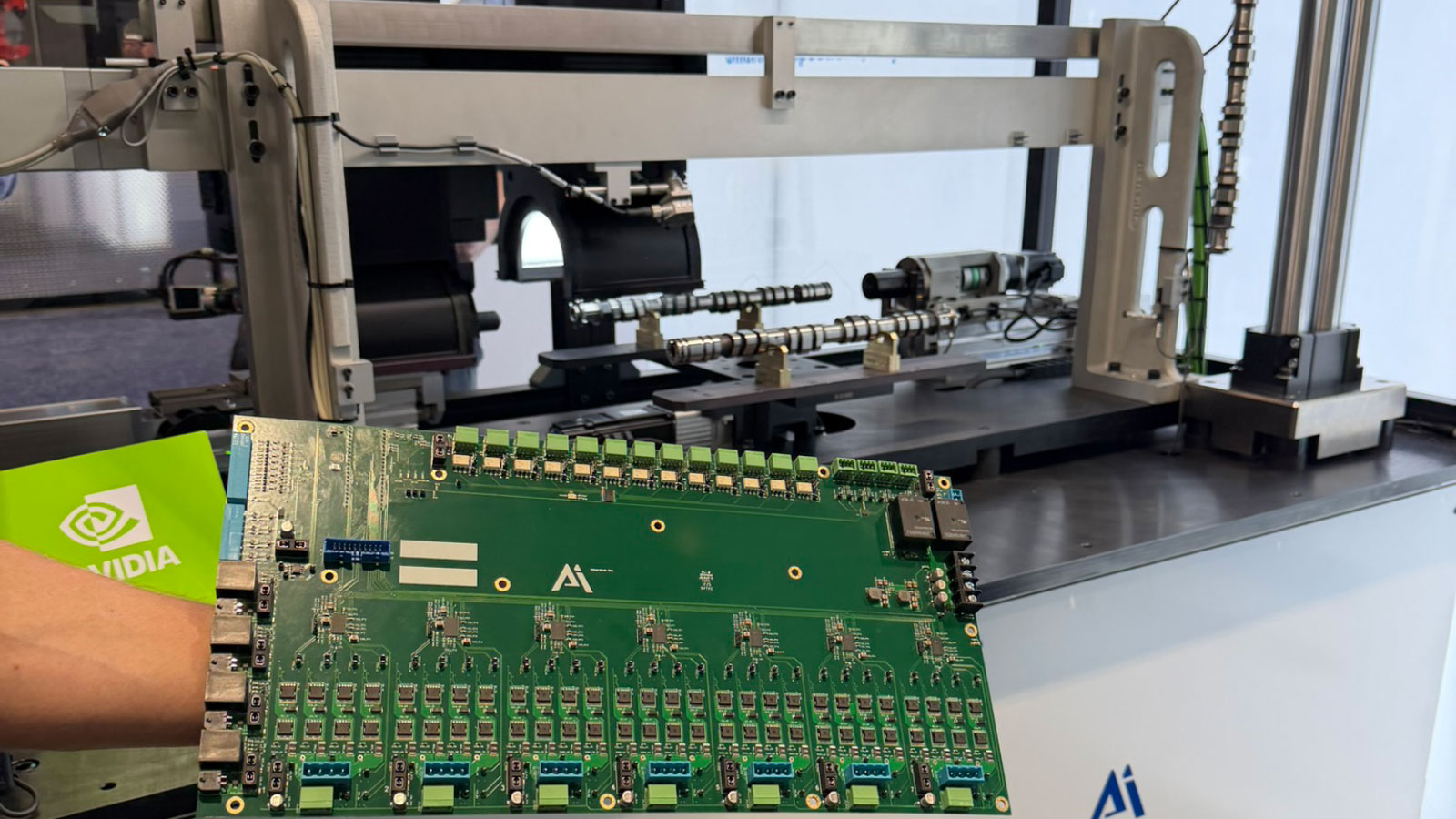
Integrated AI is at the heart of the Gen2 inspection system from Musashi AI. Shown here is the camshaft inspection demo from Automate 2026.
Artificial intelligence has become one of manufacturing’s most discussed technologies, but few applications deliver measurable business value as directly as automated visual inspection. Musashi AI’s second-generation inspection platform demonstrates how deep learning, advanced optics and intelligent automation are helping manufacturers reduce the true cost of quality—while solving inspection problems that conventional machine vision simply cannot.
For decades, manufacturers have accepted visual inspection as a necessary compromise. Human inspectors bring experience and intuition, but they also tire, disagree and struggle to maintain consistency over long production shifts. Conventional machine vision systems solved many straightforward inspection tasks, yet they often reached their limits when confronted with highly complex components featuring intricate geometries, reflective surfaces and dozens of potential defect types.
Musashi AI believes those limitations no longer have to define the economics of quality.
Developed originally to solve inspection challenges within Musashi’s own global manufacturing operations, the company’s AI-powered inspection technology has evolved into a commercial platform serving automotive manufacturers and suppliers worldwide. Its latest product, the Gen2 Inspection System, represents far more than an incremental hardware upgrade. It is a redesign of how artificial intelligence, optics and automation work together to inspect complex manufactured components.
At first glance, the system resembles a sophisticated machine vision cell. Beneath the enclosure, however, is an architecture built around Musashi’s Active i® deep learning models rather than traditional rule-based programming.
The system is designed to inspect geometries and surfaces that can’t be handled by the typical cameras and sensors available from catalog suppliers, says Frederick Reinink, Business Development Manager at Musashi AI. The company’s demo at Automate 2026 featured automated inspection of camshafts. “Those off-the-shelf products are really good for less complex inspection applications… but this is a really complex part that is inspected.”
From Internal Innovation to Commercial Product
Like many successful industrial technologies, Musashi AI’s inspection platform began as an internal solution to a manufacturing problem.
Musashi Corporation, a global supplier of precision automotive components including gears, shafts and differential assemblies, required an inspection system capable of reliably evaluating parts that conventional vision systems struggled to inspect. Rather than outsource the challenge, the company assembled software automation specialists to develop its own AI-based inspection platform.
Today, that internal innovation has become Musashi AI, with installations both inside Musashi manufacturing facilities and at external automotive manufacturers. Reinink says using its own production operations as an early proving ground has accelerated product development while giving prospective customers confidence that the technology performs under real production conditions.
The newest evolution is Gen2.
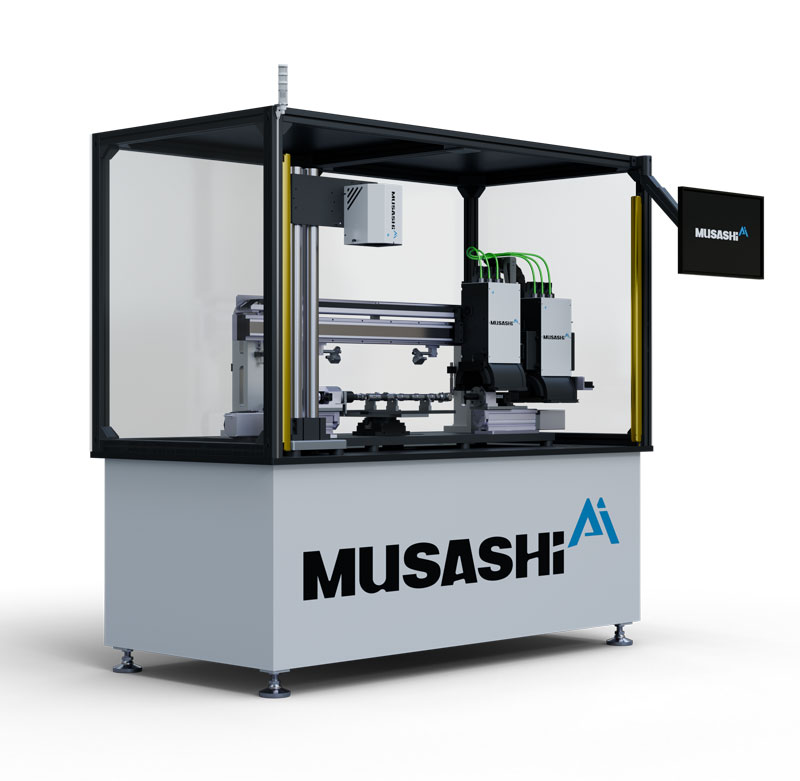
The Gen2 Inspection System from MusashiAI uses embedded AI to handle complex inspection challenges.
AI at the Center
Because the company has significant capabilities in robotics, vision systems and motion control, they often work closely with system integrators to provide the best mechanical solution for customers. And although Gen2 incorporates specialized hardware, industrial cameras and precision optics, Musashi AI considers itself fundamentally an artificial intelligence company.
The focus on AI is one of the key differences and advantages of the Gen2 inspection system.
“We’ve decoupled the AI inspection and the part handling,” says Shawn Fitzpatrick, Director of Engineering. “That also allows us to achieve a much lower cycle time and we can get a much higher throughput of parts with the same system.” He continues, “Your part handling only needs to worry about part handling. Your AI only worries about AI, where our Gen1 system had a bit of both happening at the same time, so our cycle time was a little bit larger than we were hoping for.”
Musashi AI carried that philosophy throughout Gen2’s mechanical design as well, standardizing its own inspection platform while allowing customers to integrate it with the PLCs, robots and automation systems already deployed throughout their factories.
That flexibility reduces engineering effort during implementation while simplifying future upgrades—an important consideration for manufacturers seeking to adopt AI without replacing existing automation investments.
“We’ve built the Gen2 to be modular,” Fitzpatrick explains. “Customers don’t want to keep going from Generation One to Generation Two to Generation Three. They want modular pieces to be updated.”
Deep Learning at the Edge
Behind the inspection hardware sits what may be Gen2’s most important component: its artificial intelligence engine.
Unlike cloud-based AI applications, every inspection decision is processed locally inside the machine.
“All of the AI that’s being processed here—there’s an industrial PC within the system,” Reinink explains. “So it’s edge-based AI.”
Running AI inference at the edge offers several advantages for industrial environments.
First, inspection decisions occur in milliseconds without relying on internet connectivity or remote servers. Second, manufacturers maintain complete control over sensitive production information. Finally, the architecture supports deterministic cycle times—an essential requirement for automated production lines where inspection cannot become the bottleneck.
“We rely on NVIDIA GPUs for inferencing and model training as well,” Reinink says. “They’ve been a really good partner.”
Perhaps even more interesting is how Musashi AI addresses one of the industry’s emerging challenges: preserving the value of historical inspection data when hardware generations change.
Many customers have accumulated years of inspection images using Gen1 systems. Simply replacing the hardware could make that data difficult to reuse because new cameras, optics and lighting create images with different characteristics.
Musashi AI is leveraging NVIDIA’s synthetic data generation technologies to bridge that gap, so that the Gen2 doesn’t have to be completely retrained from scratch.
Seeing What Conventional Vision Systems Cannot
The effectiveness of any automated inspection system begins with the images it captures. But for complex components like camshafts, gears, splined shafts and other precision-machined parts, obtaining usable images is often the hardest part of the problem.
Highly polished surfaces create reflections. Complex geometries cast shadows. Tiny scratches may disappear depending on lighting angle, while harmless machining marks can appear to be defects. Traditional machine vision systems frequently compensate by tightening inspection thresholds, which often increases false rejects and creates additional downstream costs.
Musashi AI approaches the challenge differently.
Rather than relying on a single imaging modality, the Gen2 platform combines multiple inspection techniques within the same machine, allowing each technology to evaluate the type of defect it detects best.
“We’re able to mix different inspection types into the same machine,” explains Fitzpatrick, who demonstrated the concept using the display setup at Automate 2026. “We’re doing a surface inspection where we’re looking at the surface of the camshaft. Then you’ll see that light go off and the laser come on. Now we’re doing a chatter inspection.”
That flexibility allows one inspection station to perform several specialized analyses during a single inspection cycle.
For surface defects, high-resolution industrial cameras capture images under carefully controlled illumination. For chatter detection—a characteristic waviness created when a grinding wheel begins to loosen—the system switches to laser-based inspection capable of revealing subtle surface profiles invisible to conventional imaging.
Traditionally, manufacturers have relied on tactile metrology equipment to identify chatter. Detecting the same condition using a completely non-contact inspection process represents a significant advancement, particularly for high-volume production where every second of cycle time matters.
Every Customer is Unique
Musashi AI customizes those models for every customer and every application.
“We’re very application specific,” Reinink explains. “When we take on a customer, we have to understand what their quality requirements are for their parts, and then our software will match that. Our models are tuned to train specifically for that customer.”
That customer-specific approach is particularly important because quality itself is rarely binary.
Many precision-machined components may exhibit dozens of possible defect types, each with unique acceptance criteria. A small scratch might be acceptable in one location but unacceptable in another. Surface porosity may be permissible below a certain size or frequency, while chatter marks may require completely different evaluation criteria.
As Reinink explains, “These parts could have 30 potential failure modes… Sometimes at a certain size the defect actually passes—it meets the quality specification—but if there’s a certain frequency or if it exceeds the threshold, then it has to be contained. It’s not just flagging things for pass/fail. It’s assessing things based on where it’s happened, the size of the defect, and the frequency of the defect, and that is part of our full software package.”
Engineering for Production, Not the Laboratory
Artificial intelligence may capture attention, but manufacturing customers often judge inspection systems by much simpler criteria.
- How fast is it?
- How easy is it to maintain?
- How long will production be down if something fails?
Those practical considerations shaped nearly every aspect of Gen2’s mechanical redesign.
“We’ve improved cycle time,” Reinink says. “This Gen2 system has the ability to ship with two inspection heads, effectively doubling the coverage and improving the cycle time.”
By increasing inspection coverage within a single station, manufacturers that previously required multiple inspection cells can often achieve the same throughput using fewer systems.
The result is lower capital investment, reduced floor space requirements and simplified integration.
Maintenance received equal attention during development.
“Downtime is very precious,” Fitzpatrick says. “If we need to change out a camera, we’ve really thought about how we can engineer this solution to make swapping out a camera and calibrating a head as quick as possible.”
Instead of replacing individual components inside the machine, Gen2 uses fully modular inspection heads.
These heads are completely modular,” Fitzpatrick explains. “You can unplug the cables and it’s four bolts… You can have a spare inspection head that is calibrated and ready to go, so within minutes you’re back up and running.”
The design reflects a growing emphasis throughout industrial automation on maintainability as a competitive advantage. In high-volume manufacturing, reducing downtime by even a few minutes can save thousands of dollars in lost production.
To ensure inspection accuracy remains consistent after maintenance, every inspection head is calibrated during manufacturing and periodically verified using an integrated calibration standard within the machine.
“We have a calibration record of each of the inspection heads,” Fitzpatrick says. “Plus we have a calibration block… where the inspection heads determine whether their calibration is still in spec.”
Turning Inspection Data into Manufacturing Intelligence
For many manufacturers, the inspection itself is only half the value proposition. Every image captured, every defect identified and every inspection decision represents data that can be used to improve manufacturing performance.
Recognizing that opportunity, Musashi AI developed its Cendiant® Quality Insights (CQI) platform alongside the Gen2 inspection system. Rather than functioning as a simple repository for inspection records, CQI transforms production data into actionable quality intelligence for engineers, supervisors and plant managers.
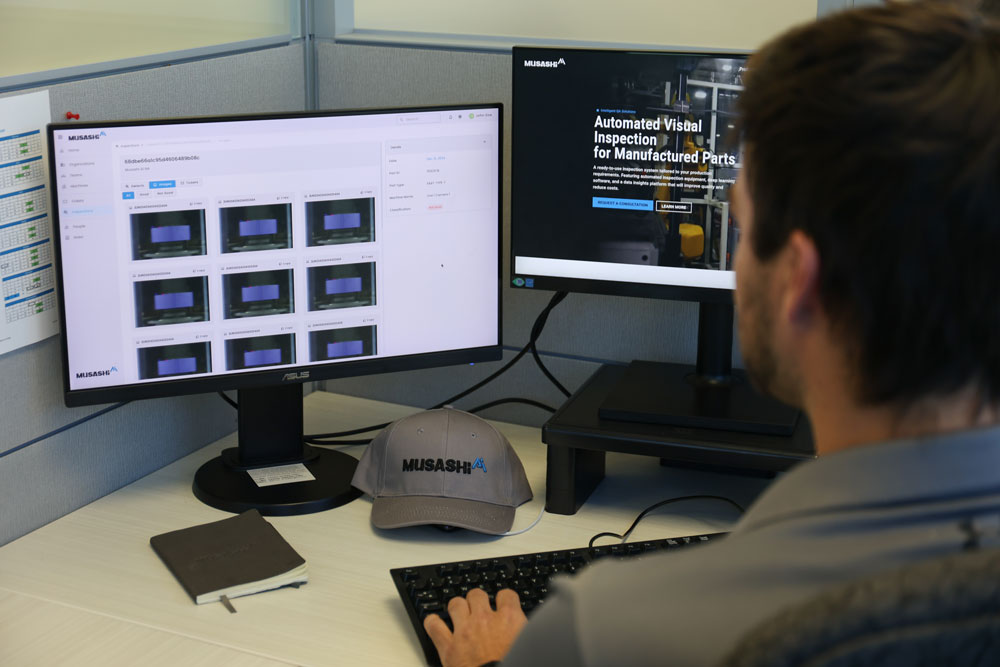
The Cendiant® Quality Insights (CQI) platform provides centralized information about quality data captured on the plant floor.
“The architecture is built around an organization and then different plants,” Fitzpatrick says. “If you have a large manufacturer with multiple plants, they can drill down and say, ‘I want to see how my quality is at a business level, then at a plant level, then at a line level.’”
The platform aggregates production metrics across an enterprise, allowing users to move seamlessly from a corporate overview down to individual production lines. Instead of simply reporting pass/fail results, the dashboard provides detailed information on defect frequency, defect types, production throughput and inspection trends.
Perhaps most importantly, CQI gives manufacturers the ability to experiment with quality thresholds using actual production data.
“Customers wanted a little bit more freedom to control their own quality metrics,” Fitzpatrick explains. “Sometimes they like to change that or explore what happens if they had a threshold adjust. Here we can actually explore what happens if we take that defect off or change a threshold. How does that impact my overall yield from the plant?”
For manufacturers introducing new products or refining inspection specifications, that capability provides valuable insight into the relationship between inspection criteria, production yield and overall quality performance.
“With new customers,” Fitzpatrick continues, “they have always subjectively analyzed quality. Well now you’re quantifying that. They’re not actually sure what some of the values of these specifications should be, so this platform will allow them to dial in and determine them.”
Keeping Humans in the Loop
Although artificial intelligence drives inspection decisions, Musashi AI has deliberately avoided creating a completely autonomous learning system.
Instead, Gen2 employs what engineers refer to as a “human-in-the-loop” workflow.
Within the CQI platform, users can review inspection images, identify questionable classifications and submit feedback directly to Musashi AI through an integrated ticketing system.
“So here is how we actually train the data,” Fitzpatrick says. “Through this ticketing system, we allow customers the ability to say, ‘The AI needs to be tuned a little bit differently than it currently is.’”
He continues, “All of our AI is done with an engineer in the loop. This is how we then take that data, retrain the model and update it based upon the customer’s input and how things are happening at the customer’s site.”
That collaborative approach reflects an important reality of industrial AI. Manufacturing environments evolve continuously as tooling wears, raw materials change, suppliers vary and customer quality expectations become more demanding. Rather than expecting a model to remain static for years, Musashi AI treats AI development as an ongoing partnership with each customer.
Building Traceability into Every Component
Increasingly, manufacturers are expected to provide complete traceability for every component they produce. Automotive, aerospace and medical industries all demand detailed production records that can be retrieved years after a product leaves the factory.
Gen2 was designed with that requirement in mind.
“Most components today are serialized, either by laser engraving or dot peening,” explains Reinink. “Our system reads that, captures all of these images and that inspection record for traceability. You can access that through the CQI.”
By linking serialized components with complete inspection histories—including images, AI decisions and operator actions—manufacturers gain powerful audit capabilities while strengthening product accountability throughout the supply chain.
The CQI platform has also been designed with enterprise cybersecurity in mind.
“We’re going through SOC 2 compliance right now,” Fitzpatrick notes. “That’s another big attraction to our customers—the ability that our cloud platform is SOC 2 compliant, ensuring that we’re following security best practices and standards.”
Measuring Success by the Cost of Quality
Although artificial intelligence often dominates discussions surrounding automated inspection, Reinink believes customers ultimately evaluate the technology using a much simpler metric. Asked to summarize the system’s value proposition, he answers without hesitation.
“Basically, the cost of quality.”
That cost extends well beyond inspection labor.
Without automation, manufacturers frequently rely on teams of inspectors to visually examine finished parts. Those employees perform valuable work, but manual inspection is inherently variable, labor-intensive and increasingly difficult to staff.
“This system could augment—or allow those operators to go to more value-added activities,” Reinink explains. He adds that, depending on the application, the automated inspection could relieve as many as three to six operators to perform other duties. “So it’s pretty substantial.”
The larger financial impact, however, often comes from preventing quality escapes.
“Cost of quality is also quality escape,” Reinink says. “That’s when something gets out that shouldn’t get out. That can be very costly, whether it’s caught at assembly or, worst case scenario, as a roadside failure. Containing quality and getting reliable, accurate inspection is a key value proposition.”
Beyond identifying defective components, Gen2 generates the production data manufacturers need to reduce defects at their source.
Expanding Beyond Automotive
Although Musashi AI’s roots are firmly planted in automotive manufacturing, the company’s ambitions extend much further.
Its earliest commercial success naturally came from inspecting complex automotive components such as camshafts, gears and shafts. Yet the underlying technology is applicable anywhere manufacturers produce high volumes of precision parts requiring reliable visual inspection.
“We are branching out,” Reinink says. “Strategically, we are looking outside of automotive where there’s an opportunity to leverage the same sort of technology—typically anybody that has high-volume manufacturing of complex parts and wants to automate that process.
As AI models continue to improve and imaging technologies evolve, opportunities are likely to expand into additional industrial sectors, Reinink says.
The Future of Intelligent Inspection
Artificial intelligence has generated no shortage of headlines in recent years, but manufacturing has often taken a cautious approach to adoption. Unlike consumer applications, industrial AI must deliver measurable improvements in accuracy, productivity and return on investment before manufacturers are willing to deploy it on production lines.
Musashi AI believes the technology has reached that point.
“Ten or fifteen years ago this wouldn’t even have been possible because the AI wasn’t in the position to deliver this,” Reinink says. “Seeing that technology actually having an impact both at the manufacturing site and then, if you think about it, the end customers—people on the road driving these vehicles—they’ve got better vehicles. They’re safer. They’re just built better. That’s amazing. That’s great for society.”
As manufacturers continue their digital transformation journeys, AI-powered inspection is poised to become more than just another automation tool. It is increasingly emerging as the foundation of data-driven quality assurance—one capable not only of finding defects, but of helping manufacturers eliminate them altogether.