Dunkermotoren Expands Decentralized Motor Line
dGo Brushless DC motors with integrated commutation electronics allow speed-controlled axes without a servo drive or fieldbus
Published August 12, 2026

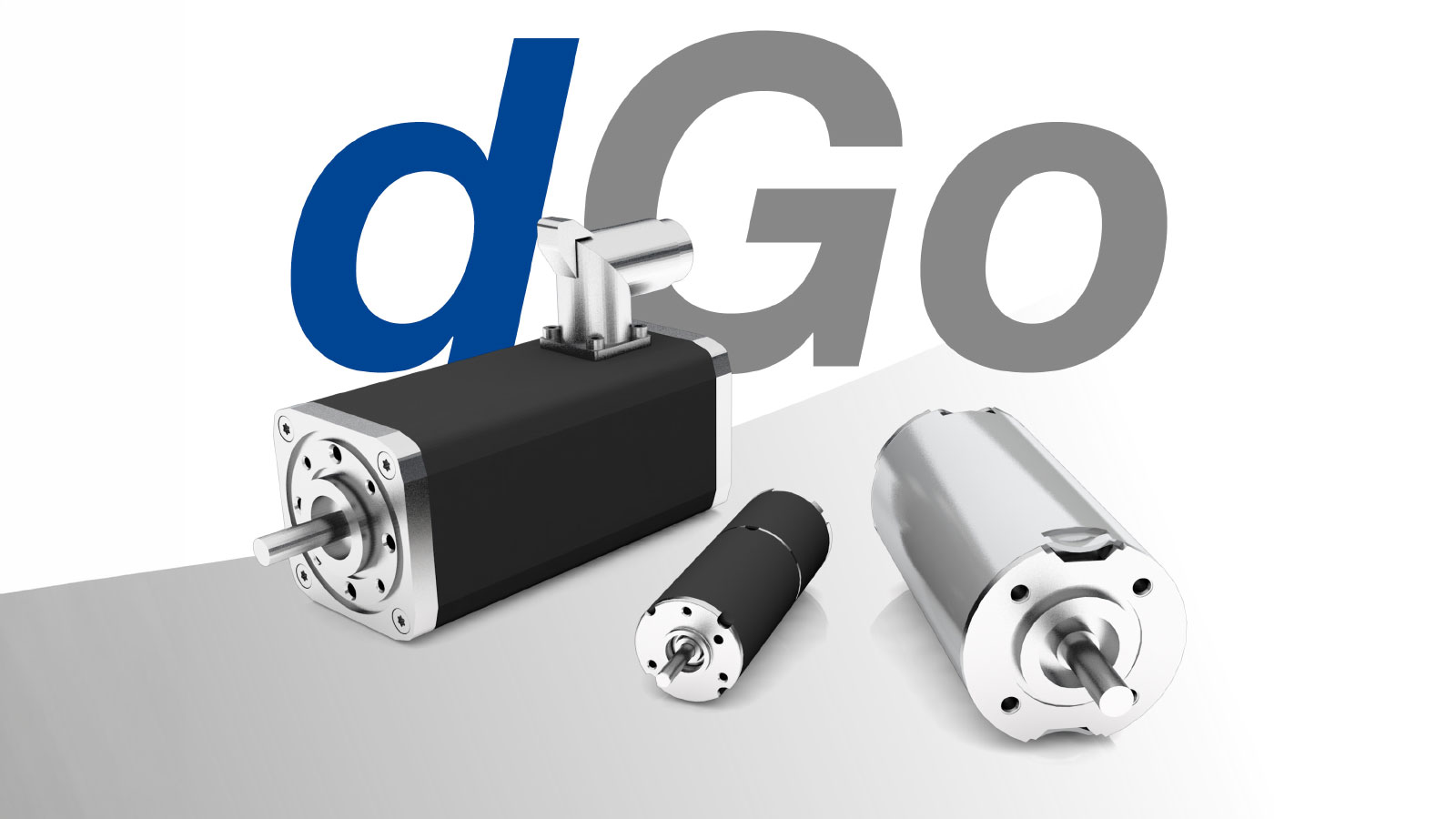
BLDC motors require electronic commutation to generate the rotating magnetic field that drives the rotor. In conventional systems, this function is performed by an external controller connected to the motor through separate power and feedback wiring. dGo integrates these electronics directly into the motor.
Dunkermotoren expanded its Smart motor line with the new dGo motor family—brushless DC motors with integrated commutation electronics that let machine builders add speed-controlled axes without a servo drive or fieldbus connection. dGo joins dCore, dMove and dPro as the entry level of drive intelligence within one fully compatible platform, so OEMs can scale from simple speed control to full positioning without changing motor families.
Modern automation systems often include auxiliary motion axes that require reliable speed control but do not need advanced positioning, synchronized multi-axis motion or an industrial Ethernet connection. Using a fully programmable servo drive for every conveyor roller, pump or secondary machine axis can increase hardware cost, wiring effort and commissioning time without adding practical value to the application.
Dunkermotoren dGo motors combine a brushless DC motor with integrated commutation electronics and application-oriented control functions. Depending on the version, motor speed can be adjusted via supply voltage, analog input or PWM signal, while digital inputs support functions such as start, stop and direction selection. The result is a compact and easy-to-integrate drive solution for repeatable motion tasks.
Within the Dunkermotoren portfolio, dGo represents the entry level of drive intelligence for speed-controlled applications, while dMove and dPro provide advanced control, communication and positioning capabilities for more demanding motion tasks.
Integrated electronics for simplified machine design
BLDC motors require electronic commutation to generate the rotating magnetic field that drives the rotor. In conventional systems, this function is performed by an external controller connected to the motor through separate power and feedback wiring. dGo integrates these electronics directly into the motor.
For machine builders, this means fewer components, reduced wiring effort and simplified installation. The integrated architecture is particularly suitable for standardized OEM applications where compactness, reliability and efficient assembly are more important than freely programmable motion functionality.
dGo is designed for applications requiring dependable speed control rather than complex positioning tasks. Its application-oriented functionality enables decentralized motion without the additional hardware and engineering effort associated with a fully programmable servo drive.
Three Product Families for Different Requirements
The dGo portfolio comprises the BGA 22 dGo, BG 42 dGo and BG 45 dGo series, allowing machine builders to select the most suitable solution according to available installation space, power requirements and operating conditions. Across the dGo portfolio, machine builders can select from a range of performance and integration options tailored to their application requirements:
- BGA 22 dGo with up to 24 W continuous output power and up to 236 W peak output power
- BG 42 dGo with up to 96 W continuous output power and up to 214 W peak output power
- Integrated commutation electronics for decentralized drive architectures
- Analog, PWM and digital I/O control options, depending on the motor version
- Compatibility with suitable gearboxes and brakes
- Protection ratings up to IP65 for the BG 45 dGo
The BGA 22 dGo is a compact, slotless three-phase BLDC motor with integrated commutation electronics. Its coreless design eliminates cogging torque and supports exceptionally smooth and quiet operation. Depending on the configuration, the motor can be operated through a simple two-wire connection or via multiple control inputs for start and stop functionality, direction selection, and analog or PWM speed control.
The motor delivers continuous output power of up to approximately 24 W and peak output power of up to 236 W, depending on the winding and operating conditions. Its compact design makes it particularly suitable for applications with limited installation space and moderate continuous power requirements.
The BG 42 dGo is designed for applications requiring higher continuous output within a compact 42 mm motor diameter. Featuring an eight-pole neodymium magnet system and integrated four-quadrant speed control, it provides continuous output power of up to 96 W and peak output power of up to 214 W.
Analog speed control and direction selection support straightforward integration into machine architectures, while the Dunkermotoren Modular Motion System allows the motor to be combined with suitable gearboxes, brakes and other drive components.
The BG 45 dGo extends the concept to a more robust motor platform with protection ratings up to IP65 and support for various optional attachments. Sharing the same application-oriented operating philosophy as the BG 42 dGo, it combines straightforward speed control with enhanced mechanical integration options, making it suitable for more demanding industrial environments.
Four-Quadrant Operation for Reversible Applications
The BG 42 dGo and BG 45 dGo feature integrated four-quadrant speed control, enabling controlled acceleration, deceleration and reversing in both rotational directions. This functionality is particularly beneficial in conveyor systems, reversible transport sections and other applications that require frequent direction changes or controlled braking. As with any regenerative drive system, machine designers must consider braking energy, load inertia and power supply behavior when sizing the complete system.
A key advantage of the dGo concept is its focus on essential functionality. Supported variants accept analog or PWM speed references, while digital inputs provide basic control commands such as start, stop and direction selection.
Because these signals can be supplied directly by standard PLC I/O, switches or simple control logic, there is no need for fieldbus configuration, network addressing or motion-profile programming. This simplifies machine architectures that incorporate multiple independent, speed-controlled axes.
Integrating the commutation electronics into the motor also reduces wiring complexity and supports compact installations. EMC performance must nevertheless be evaluated at the system level, taking cabling, grounding and power supply design into account.
Factory Configuration and Application-Specific Functionality
For OEMs, the factory customization capabilities of the BG 42 dGo and BG 45 dGo can reduce commissioning effort and help standardize machine platforms across larger production volumes. Fixed speeds, acceleration and deceleration ramps, digital output functions, current limits and numerous other operating parameters can be configured at the factory to match specific application requirements.
For larger projects, customized operating routines can also be stored directly in the motor electronics. These routines can support functions such as jam detection, autonomous motion sequences, speed-dependent current limitation and other application-specific processes. By embedding this functionality at the drive level, machine builders can limit the need for external control hardware while maintaining a compact and cost-efficient drive architecture.
Typical dGo applications include conveyor systems, roller drives, pumps, fans, sorting equipment and decentralized auxiliary axes. In these applications, the primary requirement is reliable and repeatable speed control rather than advanced motion functionality. By placing the necessary drive electronics directly at the motor, dGo reduces the need for separate controller hardware and supports efficient, modular machine designs.
Brushless motor technology also provides low-maintenance operation, making dGo particularly attractive for equipment with long operating times and recurring motion tasks.
Functionality Tailored to the Application
Selecting the appropriate drive solution begins with evaluating the application’s load profile, torque requirements, speed range, supply voltage, ambient conditions and available installation space. The selected motor and gearbox combination must then be verified against the complete duty cycle.
For applications requiring reliable speed control without advanced positioning or communication functions, dGo offers a compact and cost-efficient alternative to separate controller architectures. By integrating the electronics required for the task directly into the motor, Dunkermotoren enables machine builders to reduce complexity while benefiting from proven brushless DC technology and a flexible Modular Motion Platform.
“Many machine builders do not need the complexity of a fully programmable servo drive for every motion axis,” said Michael Burger, Productmanager at Dunkermotoren. “The dGo family focuses on the functionality these applications actually require, combining reliable BLDC performance with integrated electronics, straightforward control interfaces and application-specific configuration options.”
By integrating the electronics required for speed-controlled operation directly into the motor, Dunkermotoren dGo motors help OEMs reduce component count, simplify installation and limit overall system complexity. The result is a compact and reliable drive solution for conveyors, pumps, fans and other decentralized motion applications where straightforward speed control is the primary requirement.
Further information is available on the Dunkermotoren product page.