Exploring Decentralized Automation with Murrelektronik
Decentralized automation is increasingly the industry standard, and having watched the industry evolve for 50 years, Murrelektronik can explain why.
Published October 28, 2026
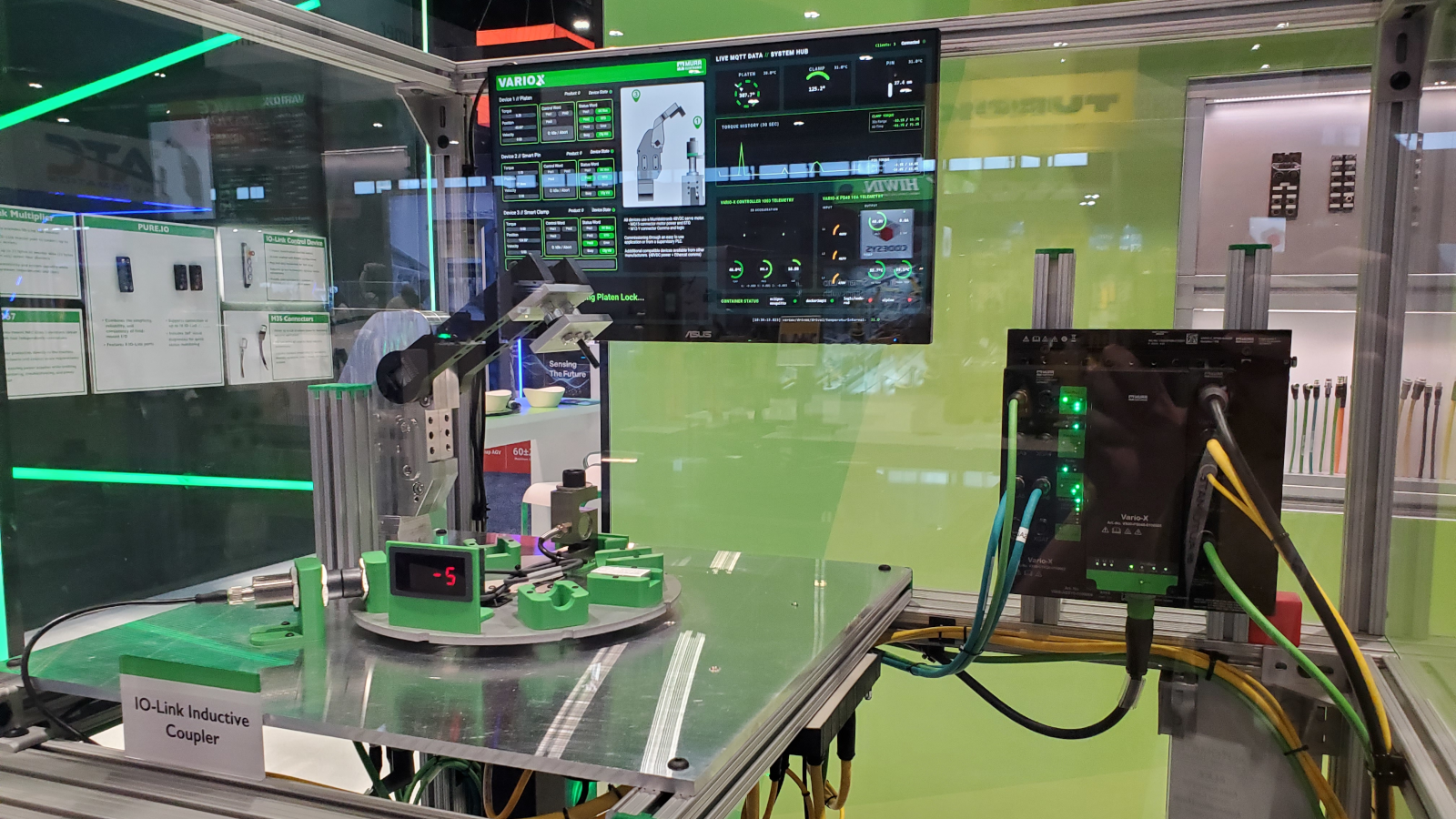
Murrelektronik's Vario-X on display at Automate 2026. The Vario-X is the flagship product that makes Murrelektronik's decentralized automation system possible.
Like a lot of subjective debates, automation best practices tend to be a bit of a swinging pendulum. It tends to be slow enough for people to rally around a few common sense ideas, but fast enough that what those ideas are changes from decade to decade. Stick around for enough decades, and you’ll even see the pendulum swing all the way back around.
In this particular case, it’s a debate over how to organize your automation. Do you centralize and pack everything into a single control cabinet like a command center for your entire factory, or do you decentralize and spread all of those components out across the floor, putting devices on the very machines they’re controlling? Both methods are proven to work, but taste, expertise and individual priorities can all lean you one way or the other.
The latest swing of the pendulum, however, has seen the industry lean ever more on decentralized automation. Lately, you see fewer articles debating the merits of each school of thought and more exploring how decentralized I/O (input/output) devices have become the “new norm.”
Murrelektronik has spent the past 50 years of that debate advocating for decentralized automation regardless of which way the pendulum’s swinging, and so there are few companies better positioned to explain how and why this has become the preferred method for many manufacturers.
The Argument for Decentralized Automation
Craig Fox, VP of Product and Innovation at Murrelektronik, has watched the march of time shift everything from the industry’s needs to its workers’ preferences in the direction of decentralized I/O.
“Quite honestly, many people are more comfortable digging in and trying to understand how their router works than they are pulling out a multimeter and trying to figure out what voltage is in your wall,” Fox said.
At least part of the debate comes down to this preference. Generations of workers raised around the internet already come into the workforce understanding the technologies they grew up with. Meanwhile, the generations that had to learn how to do it the old-fashioned way, before all that convenience, are retiring. This churn is a natural part of the pendulum’s swing. It’s just easier to find networking savvy than cable management skills these days.
This isn’t just a story about millennials killing the centralized control cabinet, though. It’s almost cliche to point out how fast-paced the modern business world has become, and one of decentralized I/O’s biggest selling points is that it can keep up with that modern pace.
That pace means that whether they're upgrading or expanding, factories change equipment more often. But every time you make one of those changes, you have to consider the potential ripple effects of doing so. With a centralized cabinet, the entire system is vulnerable to those ripples. A decentralized system is also a compartmentalized system; changing one line or machine mostly only affects its local area.
That resilience means it’s easier to keep up with your changing needs or upgrade your factory with new technology that feels like it’s releasing faster every year. You can work faster because you don’t need to consider as much of the system when making changes, and if you do miss a detail, there are already natural bulkheads to limit the consequences. Instead of overhauling your entire factory once a decade (or less), you can modify it piecemeal as you go.
Murrelektronik’s flagship product, the Vario-X, is exemplary of how this plays out in action. Rather than a single component, it’s best to understand Vario-X as a system, a full portfolio of everything from machine vision to actuator modules that can be individually installed where and when necessary to connect the various parts of an automation line.
In the process of scattering all these vital connection components across the factory floor, Vario-X also decentralizes the decision making. Using an automotive welding line as an example, Fox described how the Vario-X could receive high level commands such as to clamp down a part, then go about the middle management work of making sure every individual clamp had done so before reporting back to give the green light to begin welding.
“Being able to move logic into subprocesses is really what Vario-X can do so well,” Fox said. “You're often not going to build your whole control platform in one Vario-X. You may have multiple throughout a work cell with a supervisory PLC just being the traffic cop and saying, ‘Are you ready? Yep. Are you ready? Yep. Are you ready? Yep. Okay. Let's go.’”
Getting Specific
That’s the pitch for decentralized automation. There is, of course, also a pitch for Murrelektronik specifically.
One of the criticisms sometimes leveled at decentralized automation is how much of it is wrapped up in proprietary product suites. Many of the field’s leaders have their own ecosystems of products that don’t mix and match, and it makes sense that some manufacturers would balk at being stuck inside of one such ecosystem. That’s just trading one set of restrictions for another.
“We find that works in many ways against the customer’s interest,” Fox said. “They get leveraged into having to use equipment or make decisions because that's where their software is leading them.”
Murrelektronik has made a point of avoiding those restrictions. Using CODESYS, the Vario-X is specifically designed to work with third party software. Notably, Murrelektronik’s own in-house software, uKonn-X, is primarily marketed as a tool to help you install your automation components, not run them. Through a combination of digital documentation and scannable barcodes, uKonn-X is designed to help technicians show what plugs in where, even going so far as to activate lights on the device itself to mark where the plug should go. It’s an idea we also see being explored in other fields such as smart glasses.
In a similar vein, Fox pointed out the many value-added ways the company works with their customers, from consultation work to personalized automation plans based on their existing knowledge and processes. Because the company works with a full range of components instead of specializing in just one field, they have the expertise to build “holistic” solutions, as well as the desire to work with manufacturers to help them do the same.
“I think that's what people are looking for, people to help them,” Fox said. “Many things are becoming commoditized in a way. But what's making people stand out is the service and the relationship, how they can have suppliers that really help them and not just deliver things to the door.”