Innodisk Announces DDR5 12800 MT/s MRDIMM To Be Released Late 2026 for High-End Robotics Applications
The memory module is among the first of a new breed of RAM sticks running on a new architecture capable of answering AI’s exponentially growing hunger for more memory.
Published August 5, 2026
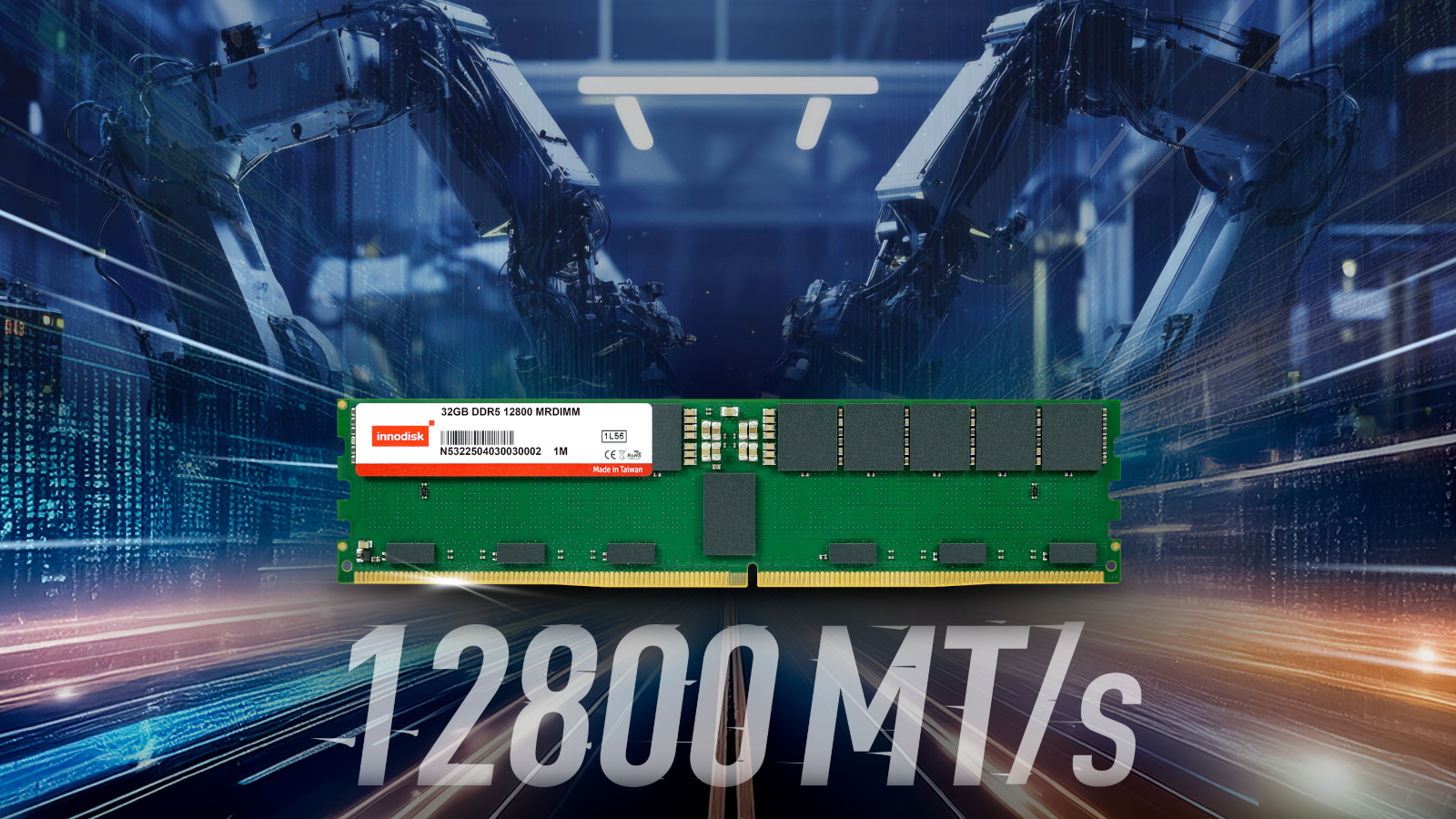
Innodisk announced the imminent release of a new MRDIMM capable of a data rate of 12,800 MT/s.
Innodisk has announced the upcoming release of their newest product, the DDR5 12800 MT/s MRDIMM, which will be available for purchase in Q4 2026 in multiple configurations ranging from 32 to 128GB of RAM.
The big headline is that data rate: 12,800 MT/s, which is widely considered the peak memory modules can achieve on the current market. Innodisk’s new module is among the first of a new class of memory architecture, MRDIMM (multiplexed rank dual inline memory modules), which allow memory modules to double their data rate while working with the same amount of RAM as previous modules. MRDIMMs first reached the market in 2024 as an answer to the needs of heavy-duty computing applications such as data servers, AI and robotic automation applications.
Chips like Innodisk’s MRDIMM tackle what the industry colloquially calls the “memory wall,” a phenomenon where the other side of the computing coin, processing power, has raced ahead of memory modules in recent years. This has led to memory bandwidth becoming the bottleneck for any cutting edge computing application.
The DDR5 12800 MT/s MRDIMM rebalances that equation with its Multiplexed Registering Clock Driver (MRCD) and Multiplexed Data Buffer (MDB) architecture. This allows a computer or server to access both ranks of RAM, which increases bandwidth by 60% compared to traditional DDR5 8000 MT/s RDIMMs and significantly improves data transfer speeds and computational efficiency. By reducing the load on the memory controller and lowering latency, this module offers a top-of-the-line memory module for those looking to implement AI in their robotics application.
As an MRDIMM, Innodisk’s DDR5 remains compatible with existing DDR5 RAM slots, which means they slot into most existing motherboards without requiring other new components to account for them. Innodisk also touted a few other proprietary technologies the module takes advantage of, including eFuse, TVS and an energy-efficient design meant to minimize power consumption at data centers.