Musashi AI Demonstrates 2nd Generation Inspection System at Automate
AI-powered inspection includes deep learning models and custom embedded control architecture
Published June 23, 2026

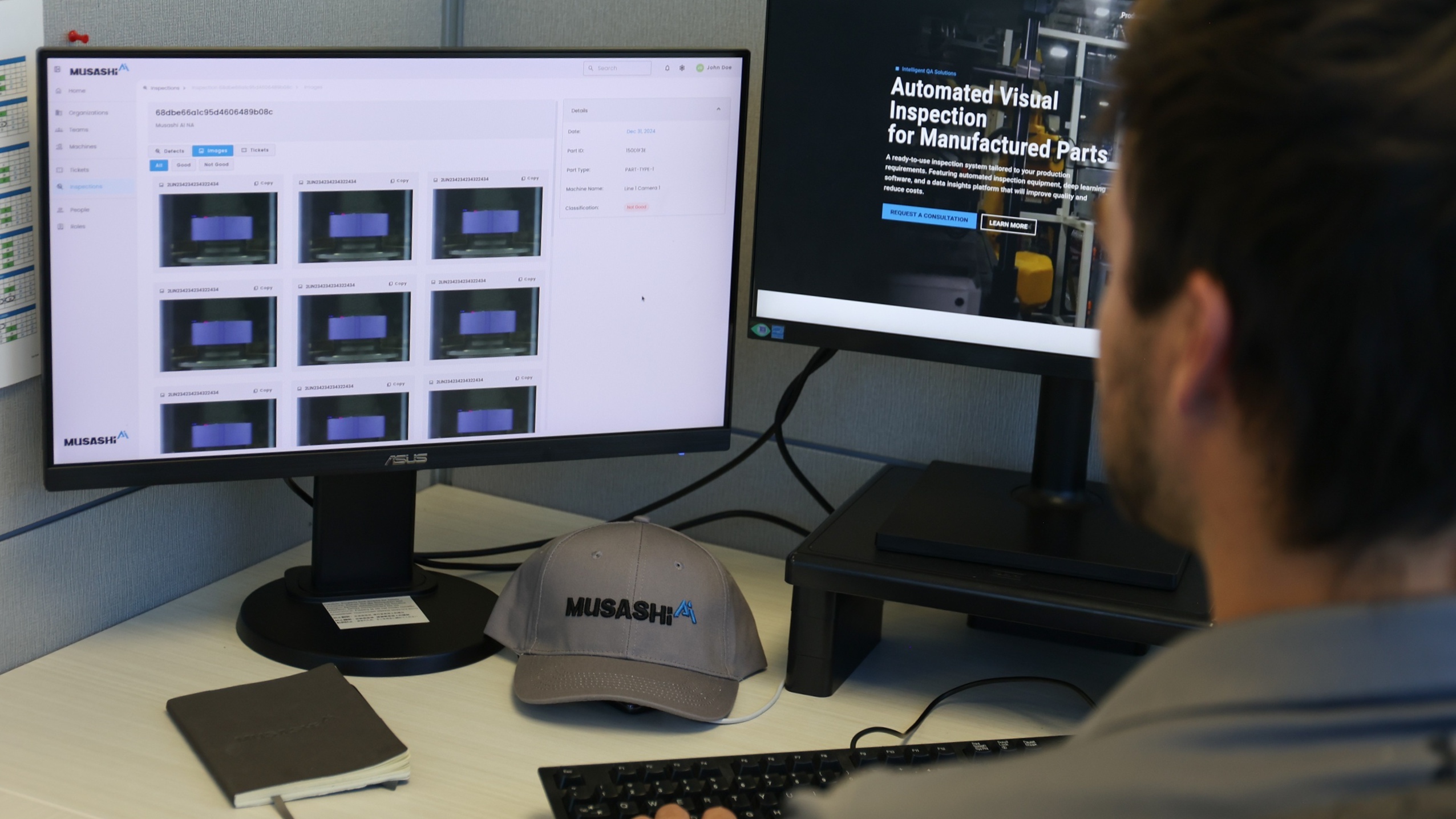
Musashi AI’s Gen 2 introduces a standardized AI-driven automated optical inspection (AOI) platform capable of scaling across a wide range of part sizes — from small precision components to vehicle doors.
Musashi AI showcased the commercial configuration of its second-generation (Gen 2) Cendiant inspection system and the latest advances in its Cendiant Quality Insights software at Automate 2026. Musashi AI demonstrated how a new generation of generalized deep learning models, Active i software, and custom embedded control architecture make AI-powered inspection faster to deploy, easier to maintain, and simpler to scale across manufacturing operations.
While earlier Musashi AI systems were engineered application by application, Gen 2 introduces a standardized AI-driven automated optical inspection (AOI) platform capable of scaling across a wide range of part sizes — from small precision components to vehicle doors. The new modular architecture can be configured across a broad range of manufacturing applications while reducing engineering effort, deployment complexity, and total system cost.
“By standardizing hardware, software, and deployment workflows, Gen 2 reduces automated inspection system costs by up to 30% while delivering time-to-value up to two times faster than older systems,” said Frederick Reinink, business development manager at Musashi AI. “These improvements allow manufacturers to deploy AI inspection more broadly while reducing implementation risk, engineering overhead and footprint when compared to the previous system.”
Smarter AI Models, Built for Industrial Scale
At the heart of Gen 2 is Musashi AI’s Active i® deep learning software, which combines multiple neural network architectures within a single inspection pipeline to maximize defect detection performance while minimizing the amount of data required to achieve production readiness.
Traditional industrial AI systems often require large datasets and extensive application-specific model training before deployment. Active i® was specifically developed to improve upon such systems. By combining complementary neural network approaches within a unified architecture, the system can identify and classify defects with significantly less training data while maintaining high detection accuracy.
The Gen 2 platform builds on this foundation through a two-stage inspection process. The first stage identifies regions of a part most likely to contain defects, and the second stage performs a detailed analysis on only those areas. This approach reduces computational overhead, accelerates model training, and improves consistency across different applications.
The system can detect anomalies as small as 50 microns without magnification while achieving a defect detection rate above 99%. Because the models can begin learning from as few as 20–30 good parts, manufacturers can launch new inspection applications with significantly less data collection and engineering effort than traditional AI approaches require.
The result is faster deployment, lower implementation costs, and a more practical path to scaling AI inspection across multiple production lines and facilities.
Enhanced Software Functionality
The latest version of Cendiant® Quality Insights further extends the value of the Gen 2 platform by transforming inspection data into actionable manufacturing intelligence. Key software enhancements include:
- Edge Access: Operators can interact directly with inspection results, images, and ticketing workflows from industrial displays on the production floor without additional PCs or separate logins.
- Mobile Device Support: Quality and engineering teams can securely access system information from Apple and Android devices.
- Multilingual Support: English and Japanese-language support is now available. Additional languages are forthcoming.
- Enterprise Connectivity: API integration with ERP, MRP, MES, and QMS platforms streamlines data exchange and reduces manual data entry.
- Enhanced Security: Gen 2 incorporates encrypted communications, role-based access controls, and continuous monitoring to meet modern manufacturing cybersecurity requirements.
Custom Embedded Control Architecture
Visitors to Booth 3837 will also have an opportunity to see Musashi AI’s custom embedded control board, which replaces the traditional PLC–industrial PC architecture commonly found in inspection systems.
The new architecture simplifies system integration, reduces hardware complexity, improves maintainability, and provides a foundation for future scalability across the broader Gen 2 platform.