Perpetually Mobile Robots
One company thinks they can keep your AMR charged. Forever.
Published July 6, 2026

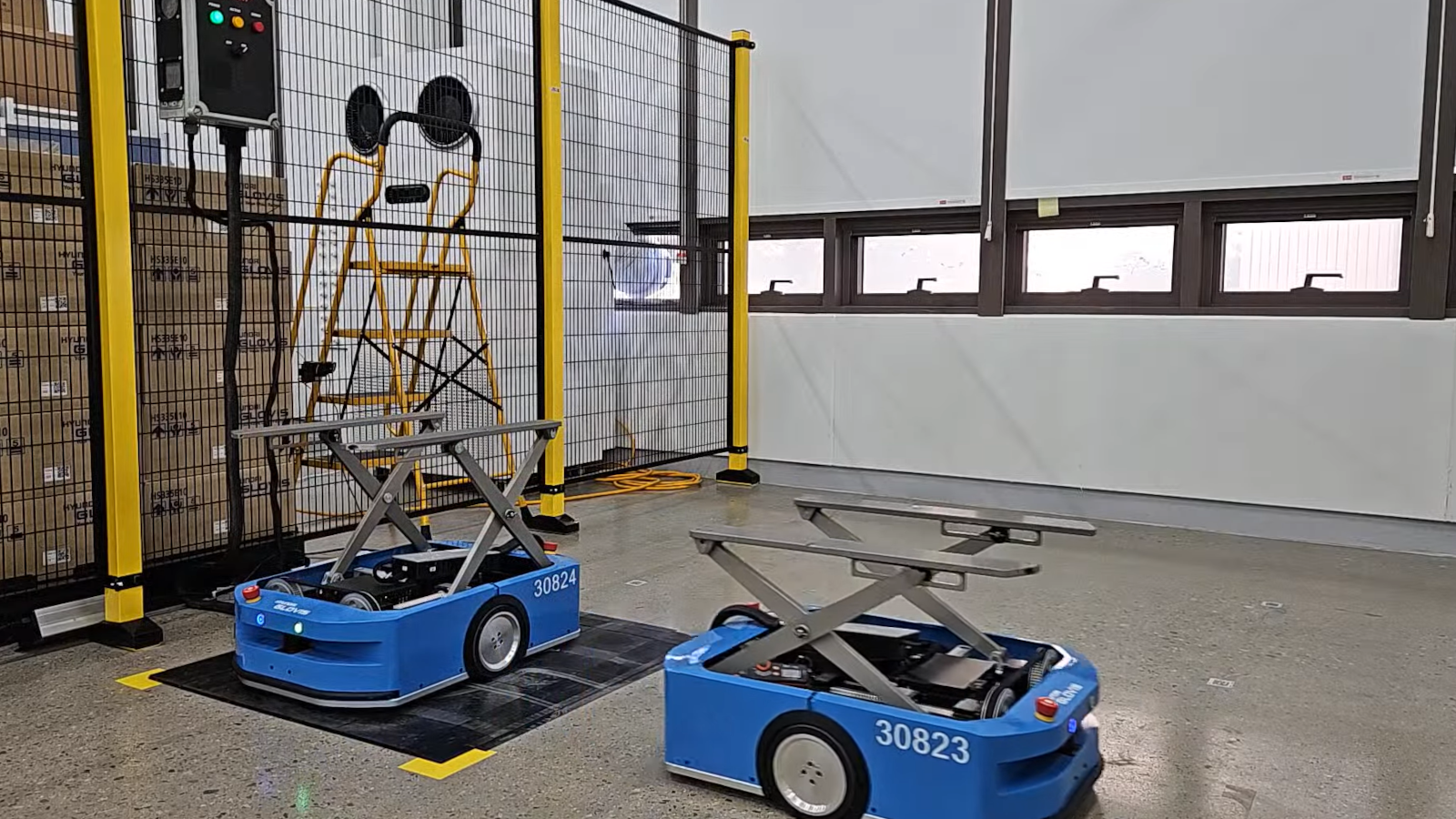
CaPow has developed a new capacitive power solution for charging AMRs designed to keep them operating perpetually.
When we were at Automate, I got a chance to see a lot of different takes on AMR technology. Fully automated warehousing systems isolated in a cage, cutting edge AMRs that operate in shared environments, and even low-tech alternatives for companies that don’t have an official “robot wrangler” on their staff. The AMR evolutionary tree has grown wide and varied.
But across them all, there are a few patterns that come up. Whether I was at a demo, panel, or booth, the first question the audience had every time, without fail, was: “What’s the operating time? What percentage of time will the AMR spend charging compared to working?”
How convenient that I’ve already been talking with energy solution provider CaPow, because their goal is to make the answer: “Forever.”
CaPow has come up with a way to entirely eliminate charging time on your AMRs. It works virtually out of the box, doesn’t require you to change a single thing about your existing facility, and is completely safe in a shared work environment. All you have to do is add some charging pads in commonly visited hot spots and receivers on your robots.
At first blush, that simply sounds too good to be true, but they have the data to back it up. Among their pile of case studies, Professor Mor Peretz, CEO of CaPow, cited a Michigan customer they’ve been helping for the past 18 months.
“Since then, not a single robot has visited a charger,” Peretz said. “No faults, no need to do any modifications on anything. It was a plug and play.”
In order to pull this off, CaPow has developed a system of charging pads that they strategically place around a facility at workstations and common thoroughfares. As the AMRs naturally work, they get small sips of charge every time they end up in these hot spots. They can spend ten seconds performing a task at a station or driving through a central highway, which charges them enough to spend a minute driving to the next hot spot, where they get another sip, and so on. Get the math right, and you achieve equilibrium, where the AMR is perpetually regaining the same amount of electricity it’s using.
The concept is simple, but the technology used to accomplish it is anything but. True to its namesake, CaPow is a capacitive power charging solution, meaning it transfers energy through the air between two metal plates instead of requiring you to directly plug or dock an AMR like other automatic charging solutions on the market do.
Capacitive power transfer is not exactly a new idea — it’s been around for over a century, and it’s long been used in components like capacitors that are a fundamental cornerstone of modern electronics. And yet, you’d be hard pressed to find another product that can replicate what CaPow does.
How We Got Here
The real design issue CaPow’s tackling is upscaling the concept. Research papers and Ivy League webinars alike have both been researching how to bring this concept to other fields like, say, electric car chargers, and most conclude that we still have a lot of work to do before we can produce a practical, marketable product.
The technology’s achilles heel is physical distance. Electricity is, generally, difficult to just pump through the air, and as the gap between plates grows, it gets exponentially more difficult to charge. In a tiny product like a capacitor on a computer chip, the gap between plates is small enough that such inefficiencies can be overcome. But a larger product means not just a significantly larger battery requiring far higher voltage transfers, but also a less efficient charge to accomplish that with.
Even for Peretz, CaPow was a 20 year journey from a university lab to a fully marketable end product. When he started investigating the technology, something like CaPow was still mostly a dream that’s only just become feasible thanks to related breakthroughs in other fields.
“Even the components and materials were not mature enough to get it to high power levels,” Peretz said. “We were fortunate enough that technology also advanced in recent years to provide high-frequency, high-voltage capabilities so we can also utilize these ideas in real, full-fledged products.”
A critical part of the solution is the introduction of a pair of antennas that communicate between the AMR and the charging pads. A lot of the advances that enable CaPow’s solution revolve around making these antennas continuously tune the networks to maintain optimal power transfer on a steady frequency, even while the AMR is moving and displacing the antenna. And while they’re locked, these antennas effectively complete a closed electrical circuit, allowing the AMR to charge.
“The idea that we put behind it is how to first identify that this changes and how to adapt and change the circuit on each end,” Peretz said. “So first, we won’t have to change the frequency. Because if you change the frequency, it would never pass standardization.”
Cars are probably still out of reach, but thanks to those advancements and a lifetime of work, Peretz’s company has assembled something genuinely new with immediate and obvious benefits for AMR-centric applications.
What Capacitive Power Can Do for You
“Keep your AMRs charged into perpetuity” is a formidable selling point all on its own, but it’s also worth looking at the additional ripple effects produced by such an accomplishment.
Reduced downtime per unit means you need fewer to cover your shifts and save money on a smaller fleet. Using a gentler charging method that doesn’t overcharge the battery also means a longer battery life with fewer failures. This is particularly important to consider in the context of lithium batteries, which can produce spectacular damage when they prematurely fail and are carried by virtually every AMR on the market.
“There is a lot of buzz today that chargers are going to have to be put in cages and have automatic extinguishers because of all the indoor-associated safety problems,” Peretz said. “We have design partners who have had their facilities totaled, with hundreds of millions of dollars of damage as a result of lithium malfunction associated with charging.”
So the logic goes: Eliminate the need for charging stations, treat these lithium batteries more gently with charging methods that wear them down more slowly, and reduce the risk of a lithium battery sparking a warehouse fire.
In general, CaPow has been very careful in regards to safety. Even as they developed their new technology, they worked hard with organizations like the IEC, UL and the FCC to establish sensible standards to govern it. Peretz spoke regularly about the efforts the company has put forth to ensure they met the robotics field’s rigorous standards.
“As much as this is a cool technology for energy transfer, our market is robotics, and in particular robotics in a highly industrial environment,” Peretz said. “This is a very conservative, strict industry.”
Rethinking Logistics
When Peretz pitches someone on CaPow, he doesn’t just talk about how it charges AMRs more efficiently. He sells it as a way of reimagining automation in the workplace, that by removing the idea of downtime entirely, manufacturers are free to unlock entirely new workflows in their factory.
In a sense, perpetual labor that does away with the idea of shifts entirely is one of the major objectives of automation and the robotics field writ large, and yet, exceedingly few applications have actually accomplished such a feat. CaPow, however, is betting that they can add AMRs to that short list.