Robots: Beyond the Curtain
Removing traditional light curtains and fencing doesn’t mean you have to sacrifice safety
Published July 7, 2026

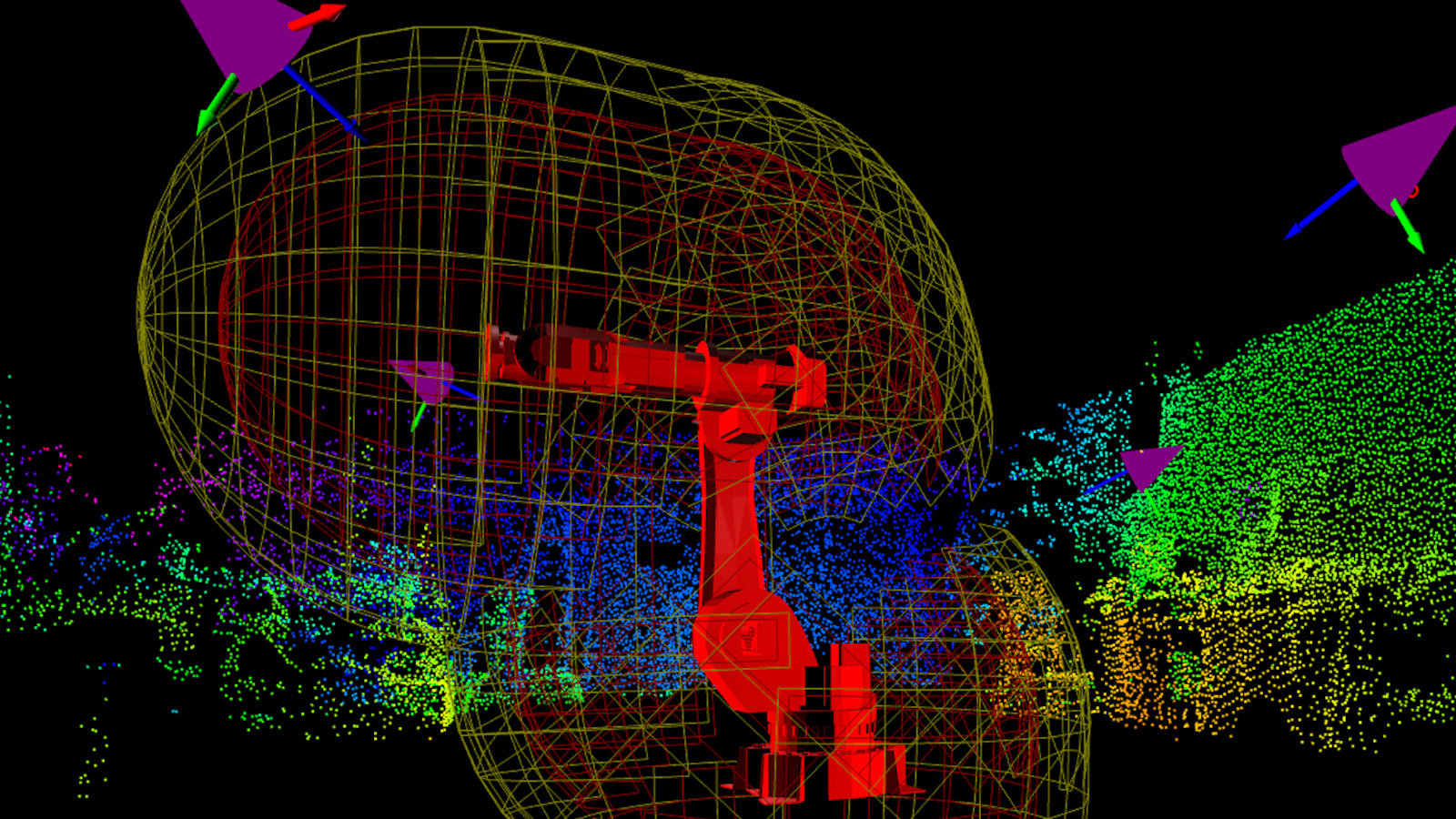
The SR-1 system from Sensory Robotics uses time-of-flight sensors to create a 3D map of the zone surrounding a robot and detect any motion within that zone.
The traditional method for ensuring the safety of humans when working near robots is to employ physical barriers to prevent workers from coming too close to dangerous equipment, or to install sensors—including light curtains and other forms of electronic fencing to shut down the machinery in case anything crosses over the line.
But with the continued proliferation of robots, including cobots and humanoid models, people are working more closely with robots than ever before.
The team at Sensory Robotics has come up with a solution that eliminates the physical barriers and the electronic curtains—without sacrificing safety. The company’s SR-1 system employs time-of-flight sensors to create a virtual spatial environment around the robot.
“Once we enter the safety zone, the robot stops,” says Mark Gagas, COO of Sensory Robotics. “And when we walk away, it resumes operation.
“That little simple thing is what opens up a lot of flexibility for manufacturers,” Gagas says. “In the 21st century, everybody's doing great things. But it's all stuck behind 20th century safety. Fences, typically. So how do you unlock that? And with a system like this, where we open up the space, we take the fences down.”
Opening Up Floor Space
One of the big advantages of removing the fencing is making more space available for other things.
“If I can give you 30% or 40% of that floor space back, you can actually do something meaningful with it,” Gagas says. “You can put inspection stations closer. You can add another robot. Everything that you can do adds output, versus this fence just guarding space that produces absolutely nothing.”
Also, the SR-1 system has the ability to differentiate between types of objects that enter its space. The system will recognize the difference between an AMR running along its route and a human approaching the robot, for example. The AMR it can ignore, but when the human comes too close. The robot stops.
At Automate, a simple demonstration employed a flat-screen TV mounted on an industrial robot arm. Whenever anyone approached the TV or the robot, the motion stopped. When the person left the area, the robot continued its programmed motion.
Saving Time Saves Money
With the SR-1 system, much of the benefit is in saved time. An operator can enter a cell, make an adjustment and leave. There’s no complicated stop/start procedure. And for a high-volume operation, saving even one minute from the process flow can be meaningful, Gagas says.
And although the SR-1 system will tend to me more expensive up-front than installing traditional fencing, the payoff can often be sooner than you’d expect.
“The ROI that we've seen has never been more than 14 months, which is kind of incredible,” Gagas says, especially when you consider the increased productivity from the use of additional floor space and the time savings related to cell entry and exit. “It's almost a no-brainer.”
The Added Benefits of Data
One of the newer features to the SR-1 system is the SR Insight platform, which turns SR-1 safety data into a live control layer for robot cells. It continuously compares real-time behavior against the approved risk assessment, flags violations or RA drift, and includes dashboards of safety and productivity metrics.
Teams can see what caused stops, slows, E-stops, human intrusions, and sensor obstructions, then drill down by time, station, and cause to fix issues fast. It also supports cross-cell benchmarking and auditor-ready logs for compliance reviews and line changes.
According to Gagas, the system can help answer questions like “How many times did my robot stop? When did it stop? How long was it down? How many people were in the cell when it happened?”
But How Safe Is It?
The SR-1 system is certified to UL 1740 and ISO 13849 (Performance Level d, Category 3), which makes it much easier for major customers to employ it in production, Gagas says, adding that the system has been installed at a number of major automotive and aerospace manufacturers over the past several years.
“Now that we've got certification, there's no more limits,” Gagas says. “This is a safety-rated system they can deploy into the field.”
Is this for Me?
Of course, not every application requires closer interaction between human and robot, and there are many use cases for which the SR-1 may not be cost justified. For example, an existing robot that already has tight fences and no need for humans to enter the safety zone will continue working just fine as-is.
Also, certain processes aren’t well-suited to being stopped in the middle. In fact, there are cases where stopping the process might result in scrapping an expensive part. In those cases, the more traditional fencing might be the better option.
But as the proliferation of cobots continues, and as manufacturers continue to look for ways to increase productivity within their existing footprint, SR-1 offers some options that open up new possibilities, Gagas says.
"