Small, Smart and Safe Motion Control
Elmo’s Approach to Improving the Performance of Servo Drives
Published August 5, 2026

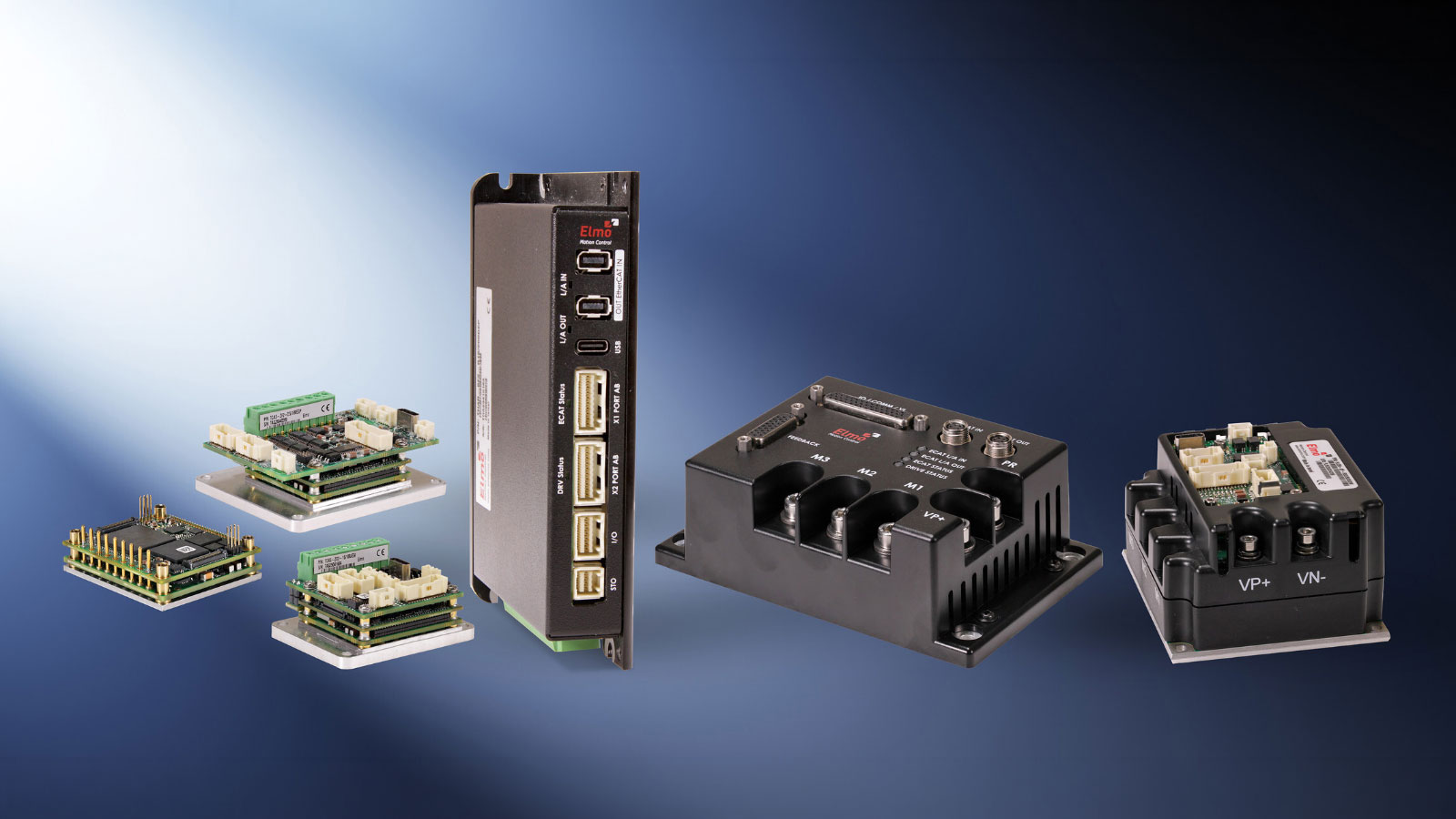
Elmo Motion Control presented a range of servo drives and controllers at Automate 2026, emphasizing increased power density and integrated safety functions.
At the Elmo Motion Control exhibit at Automate 2026, the company’s theme was “Design Small, Perform Smart and Function Safe.” We had the opportunity to sit down with Elmo’s VP of Global Marketing, Ronen Sadan, to dig into what that really means.
Design Small
Elmo aims to provide the industry’s smallest servo drives and motion controllers with the highest power density and certified functional safety features, Sadan said. “A few months ago, we released our fourth generation of product, and one of the main improvements is the size.”
While continually striving to reduce the size of its products, Elmo is also working to add functionality—like dual-axis control. In fact, Sadan pointed to the company’s new Titanium line of servo drives, noting that the Titanium Castanet measures 40 x 34 x 15.4 mm.
So instead of having a separate servo drive next to each motor, machine builders can save space by incorporating a multi-axis drive, Sadan said. Not only does this save space for the hardware itself, but it also reduces the cabling requirements. And while the dual-axis drive naturally takes up more space and a single-axis drive, it’s still remarkably small.
“I mean, it’s the size of a matchbox,” Sadan said. In addition, the dual axis drives simplify X/Y synchronization by integrating two independent servo axes into a single EtherCAT node, eliminating the need to coordinate two separate drives. The result is fewer EtherCAT nodes, a shared DC bus, reduced wiring and cabinet space, fewer network devices to configure, and a tightly integrated dual-axis architecture that streamlines machine design while delivering highly coordinated motion.
A big consideration in designing smaller servo drives is maintaining or improving power density, Sadan said. Elmo's new Titanium family addresses this with two compact solutions: the Titanium Castanet, delivering up to 1.2 kW per axis at 15A/100V, and the Titanium Harmonica, delivering up to 2.5 kW per axis at up to 25A/100V or 15A/200V, both combining exceptional power density with a compact footprint.
Perform Smart
One of the ways Elmo motion control products perform smarter is by reducing the time required for motion control to occur, Sadan said.
“We have our own IP for power switching technology,” Sadan said. "We've developed a dedicated ASIC to optimize switching performance, enabling extremely fast switching speeds. With the Titanium Castanet, we've taken the next step by introducing a GaN (Gallium Nitride) power architecture, further increasing switching speed and efficiency in low-voltage applications."
The end result of faster and smoother switching can be significant power savings, Sadan said. When a switch transitions from On state to Off state position and vice versa, there is heat dissipation, and EMI (Electromagnetic Interferences) even though nothing is happening. “If you’re able to shrink that period of time as much as possible, while maintaining a smooth transition, there will be less power loss in the system.”
In applications like warehouse and logistics AMRs, which run on battery power, that savings can result in significantly longer battery life, Sadan said.
In addition, less power loss means less heat dissipation, which means less concern with having to cool the servo drive. This results in the ability to engineer smaller, more compact machines.
Elmo supports its servo drives with its Elmo Application Studio III (EASIII) and Composer2 to enable machine designers to develop, test, and implement their own control algorithms.
“All our drivers come with the software package to do a tuning simulation before you start integrating,” Sadan said. “The software automatically assists with tuning and configuration, significantly reducing commissioning time and simplifying the integration process.”
Function Safe
One of Elmo’s goals is to bring safety to the edge—meaning that safety is incorporated into the drive itself. Elmo employs the Safety over EtherCAT protocol, known as FSoE (Failsafe over EtherCAT), and most of its devices are certified to this protocol (although some of the newer models were certification-pending at the time of this writing).
FSoE allows safety data to be transferred using the same EtherCAT network that carries the motion control information. In the end, this saves the machine builder a lot of space, because additional safety hardware and wiring are not required.
Another advantage of integrated functional safety is faster safety response, Sadan said. Because critical safety functions are executed directly within the drive, without relying on external safety hardware or additional processing outside the drive, safety-related actions can be performed with lower latency and greater efficiency.
“We like to put the computing as much as possible at the edge,” Sadan said, “to be able to react to different scenarios without having to communicate with the controller for every decision
Putting it All Together
Elmo servo drives and motion controllers find their way into a diversity of robotic applications, including robotic systems, automated guided vehicles (AGVs), autonomous mobile robots (AMRs), cobots, and exo-skeletons. But they’re also used in defense applications, semiconductor manufacturing, printing, packaging and many other industries.
Sadan summed it up: “Wherever motion is a critical component in your machine, this is where you’ll find Elmo.”