The Message from Automate 2026: Simplify
Across almost every exhibitor I talked to and every experience I had at Automate, there was a consistent message.
Published July 8, 2026

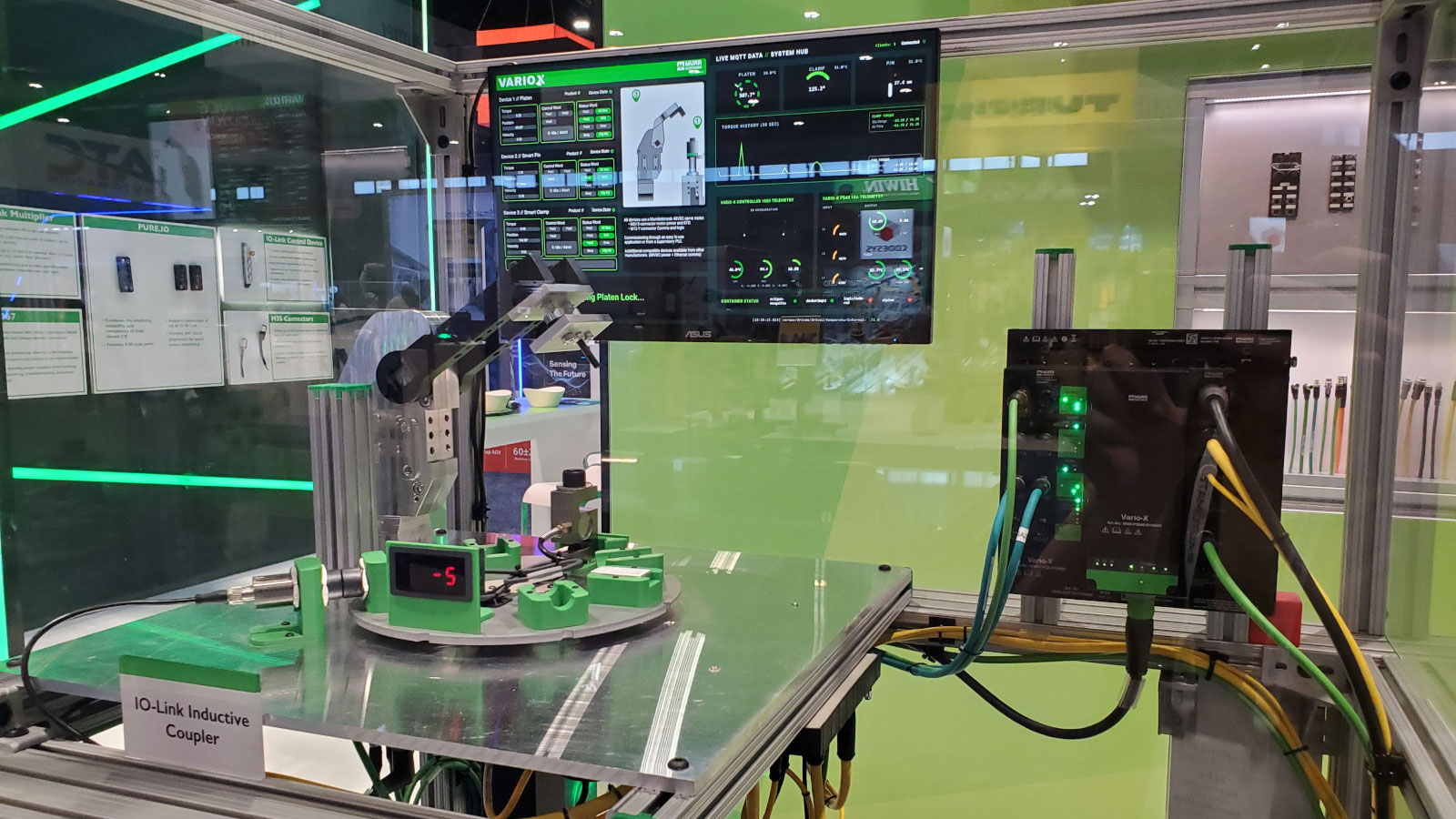
Murrelektronik was one of several exhibitors at Automate 2026, here pictured showing off their I/O software.
More and more often, I’ll get into a conversation about how much technology has accelerated over the past few decades. Inevitably, someone will remark about how crazy it is that they grew up with a landline and now everyone has a computer in their pocket and it’s off to the races. And that’s before somebody even brings up something truly new like AI. Nearly weekly, I’ll have a conversation with someone who is exhausted and overwhelmed by the sheer tide of new technology being shotgun blasted at them by marketing hypemen, eager CEOs and new workplace initiatives. These aren’t even conversations with other industry professionals — it’s everyone. This is just what life is like right now.
Set against that backdrop, I could feel that acceleration more than ever at this year’s Automate. AMRs, for example, are quickly taking over the show floor, but ask an average warehouse owner about them and you’ll mostly get a stressed, dead-eyed look. At the same time the leading companies in the field were demoing AMRs capable of safely working alongside people, other exhibitors were looking me dead in the eye and stating that such an idea was pure folly.
Walking Automate’s floor, I could watch a genuinely impressive demo marketing the newest, most sophisticated AMRs on the market, then walk two rows over into a completely different universe where a sales rep would feel entirely comfortable joking about how the ones we already have barely work. As with most things, the truth for most people is in the middle, but the gap between those two universes, between the cutting edge of what’s possible for the largest automation outfits in the world and the practical reality of what the average company experiences, is massive and widening.
You can see the gap in the target market, too. Virtually every exhibitor I talked to had the exact same target customer: mid-size and enterprise-scale companies. Here, too, you can see the gap between the average manufacturer and the Amazons and Fords of the world. I can’t help but feel that we might all be competing to sell to the same couple thousand companies, and that the more technology sprints ahead into new frontiers like humanoid robots, the more that audience shrinks to the triple or even double digits.
There comes an eventual point where that methodology becomes unsustainable and we need to focus once more on maturing and democratizing what already exists. I encountered that message everywhere this year at Automate. I’d wake up to official A3 interviews in my email talking about it. I’d hear it frankly stated by leading experts at headline panels. And I'd hear it in the knowing chuckles and nods of every exhibitor I talked to whenever I started describing the trepidation an average floor manager feels staring down the barrel of their first automation project. Across every axis, the message is identical: simplify.
We have spent the past few years making incredible strides pushing technology into realms previously reserved for science fiction, but most people have not kept up with that surge of technology. We’ve also reached the point in many of these technologies’ lifespans where the shiny newness of it all is starting to wear off and people are asking for practical applications. And that means making the technology simple enough to use.
What Simplifying Looks Like
One of the most memorable things I saw at this year’s show was a series of “AMR-like” products like Piaggio Fast Forward’s Kilo. These products are entirely predicated on accomplishing most of what a full-fledged AMR does with a fraction of the setup by just using simpler technology.
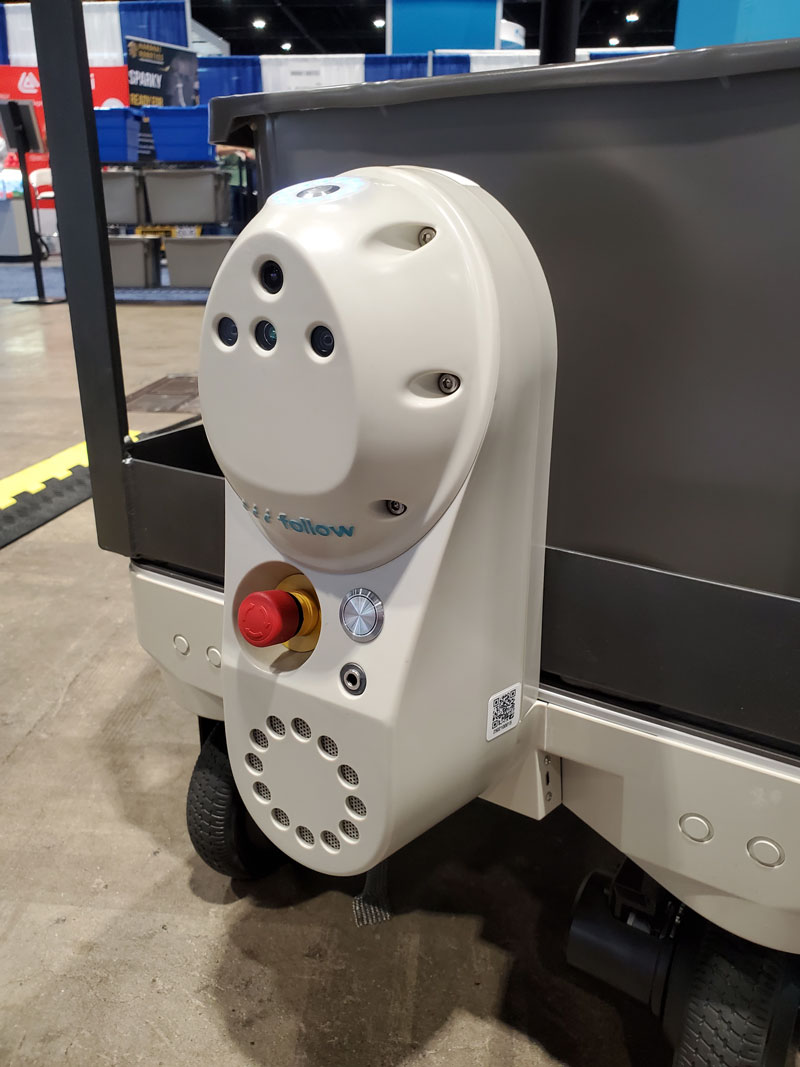
Even Omron, arguably the leader in the field, seems to recognize this is the direction the technology needs to move in. Justin King, vice president of product management, marketing and business development at Omron, had noticed a lot of the same dynamics I did.
“Ultimately, I feel like it’s a little less about specific technologies,” King said. “They’re important, but it’s more about ‘what is the experience for the user in terms of actually deploying these solutions?’ And so to the extent that we can make that easier, faster, smoother, less friction, that’s really a fundamental driver for folks to adopt these technologies, which is our goal.”
One of the critical ways Omron is simplifying the technology is with dynamic mapping. One of the biggest headaches with AMRs is how inflexible their maps can be. If one thing changes in your facility, the entire map needs to be redone. Omron, however, has developed a more nuanced mapping system that can remap a space section by section. Adjusting your space still requires remapping, but only of that local area, significantly reducing the amount of maintenance Omron’s AMRs require.
Omron wasn’t the only company simplifying automation by effectively SILO-ing it into smaller pieces. It was, in fact, a major theme across the show’s North Hall. Multiple companies from SEW-Eurodrive to Murrelektronik were all exhibiting decentralized I/O solutions that were driving towards this goal.
The idea is the same as with Omron: The more decentralized and SILO’d your solution becomes, the more agile it can be. Working this way, changing one machine or manufacturing line doesn’t require you to rewire your entire facility. You see it again here: simplify. Reduce the complexity of big picture decisions by reducing the number of potential ripple effects those decisions might cause.
Learning to Walk
In many ways, democratization isn’t just about simplifying the technology for a wider audience, but also widening the use cases that technology can fulfill. A large percentage of what I saw at the show was dedicated to this exact task, all lumped under the new umbrella term, “physical AI.”
Across the show, you could find a sensor for just about anything. Vision systems are common. Xela Robotics is selling fingertips loaded to the brim with haptic sensors to give your robot the ability to sense pressure. SiLC has a sensor that tracks velocity. A half dozen companies are all developing ways for robots to work with reflective or transparent materials. All of these products are working towards a common goal: widening the types of products robots can work with.
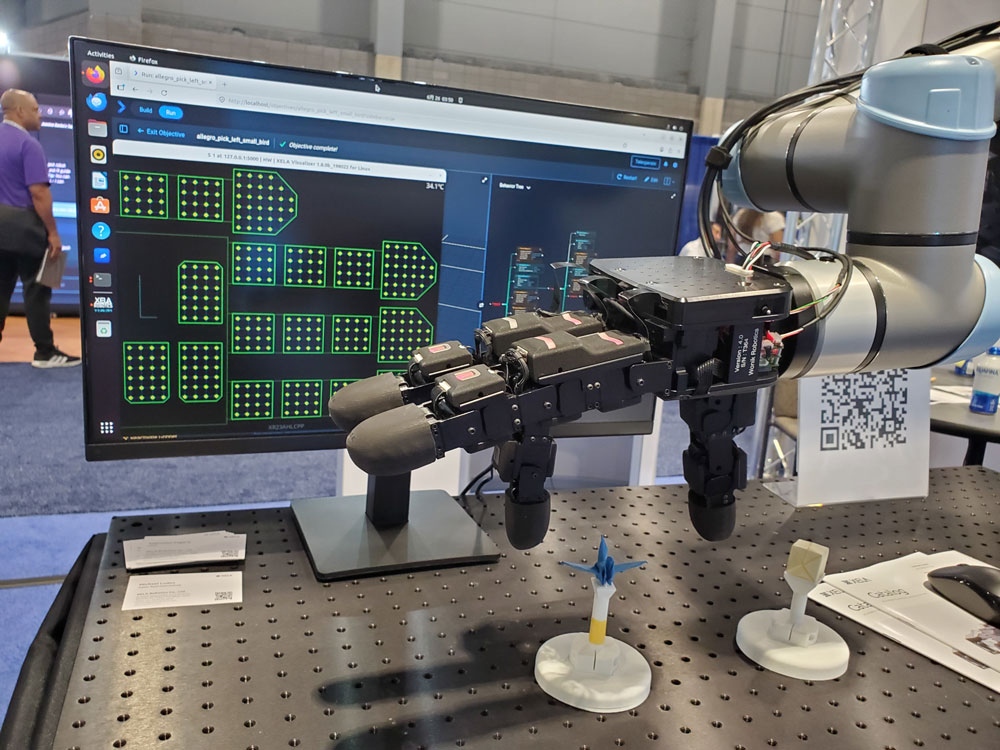
These numerous challenges are a big part of what makes robotics so complicated to deploy beyond a demo or testbed. We don’t just need to invent new technology to give robots a sense of touch, but also teach them what that information even means or why it matters. Trying to envision how to accomplish that is a fascinating and mildly existential conundrum that makes you appreciate just how sophisticated the human body is, but an entire cottage industry has materialized over a scant few months to do exactly that.
Automation Meeting You Halfway
As ever in manufacturing, many suppliers are still wise to the need to match every problem with an appropriately scaled solution.
You can see this in several places. Teguar just gave the Regis, an industrial edge PC capable of carrying a mind-boggling 96 GB of RAM, its trade show debut, but the company also sells the Scout, a much more lightweight solution (in both senses of the word) designed for mobile applications. In the current market, Teguar’s selling points go well beyond having a powerhouse product like the Regis. The computer component shortage, another growing pain of technology’s rapid progress, has suddenly made other competencies like customer service and supply line management equally, if not more, important.
Similarly, when I got a chance to talk to Baumer, they showed off a truly impressive range of sensor solutions that ranged from the dead simple to high end, precise solutions with no blind spots. And one of SEW’s many products was a low voltage line specifically designed for AGVs because other solutions would be both too heavy and complete overkill for the application.
It’s important to recognize that, even as I question whether automation might be sprinting ahead of what most people can practically implement, there are still a lot of component suppliers that understand that not every application needs the kitchen sink chucked at it. While a lot of Automate is dedicated to entirely new fields of tech, there’s also still room at this show for OEMs and end users to shop for proven, workmanlike solutions.
Meeting Automation Halfway
At places like Automate, we’ve been playing with buzzwords like “fourth industrial revolution” for well over a decade now, but it’s important to step back for a second and remember the implications of what that actually means.
The last time we had an industrial revolution was the advent of computers, which have enjoyed a long, rumbling journey to becoming a societal cornerstone over the course of half a century. Back when they were first invented, they mostly lived in the public imagination as a giant, wall-sized contraption for the likes of NASA. There was a time in even my short (by industry standards) living memory when computers were not a ubiquitous product in every home and workplace. But today, virtually every company, regardless of business sector, has an IT department.
A lot of the most immediately applicable technology I saw at Automate is specifically designed to let you start automating without having an entire robotics team on staff to manage it. But the actual reality of a fourth industrial revolution, if that does indeed turn out to be the future, is that a decade or two from now, many companies will need a robotics team the same way we all have IT as a matter of course.
That isn’t something you can build overnight. Very few salespeople on Automate’s show floor, even the most optimistic, starry-eyed among them, would recommend it. They all told me, as they’ll likely tell you, to start slow. Take on one or two robots, see how well they work for you, hammer out the kinks. Then think about scaling.
So if you want to hedge your bets, it’s prudent to start looking at establishing a pilot project sooner, rather than later. Implementation happens on a long arc. Today’s pilot will take five years to become a core part of your operations.
To illustrate this, one last anecdote from Automate: One of the many companies I got the opportunity to talk to was Burro, who have developed an ATV-like AMR capable of working outside. Anyone familiar with the technology is probably breaking into a cold sweat imagining the million ways this could go wrong in an environment as thoroughly uncontrolled as the great outdoors.
And yet, the tech works. There are hundreds of burros deployed around the world, and customers aren’t shipping them back. Burro’s CEO, Charlie Andersen, was candid about how.
The secret sauce was, simply, time. Burro has been developing their product for almost a decade, and they’ve been spending that entire time training it on every single real-world deployment they’ve maintained.
When Burro first hit the market, it had the same problems a lot of AMRs run into. Any time it encountered a funny weed or a squiggly parking lot line, the robot fell off script. But Burro solved each edge case as they came in like a programmer solving bugs, and when a bug gets solved with one AMR, the solution goes out to every burro in the fleet. Eight whole years of programming whack-a-mole later, all of those edge cases have been buffed out.
If you’ve heard about concepts like “AI training” but haven’t looked too deeply into them, this is what that process looks like in action. These are the timelines that automation and AI think in currently, and if you want to use it, it’s how you should probably think about it, too. Decisions made today are not going to get you an immediate ROI tomorrow. They are an investment for a future that’s still a decade away, but also a future that will take you a decade to reach.
In the day to day operations of a business, those are the hardest investments to justify. But they are, frequently, the investments that help companies get ahead.