Knowledge Takes Center Stage at IMTS
A show traditionally focused on hardware provides many opportunities for learning
Published August 26, 2026
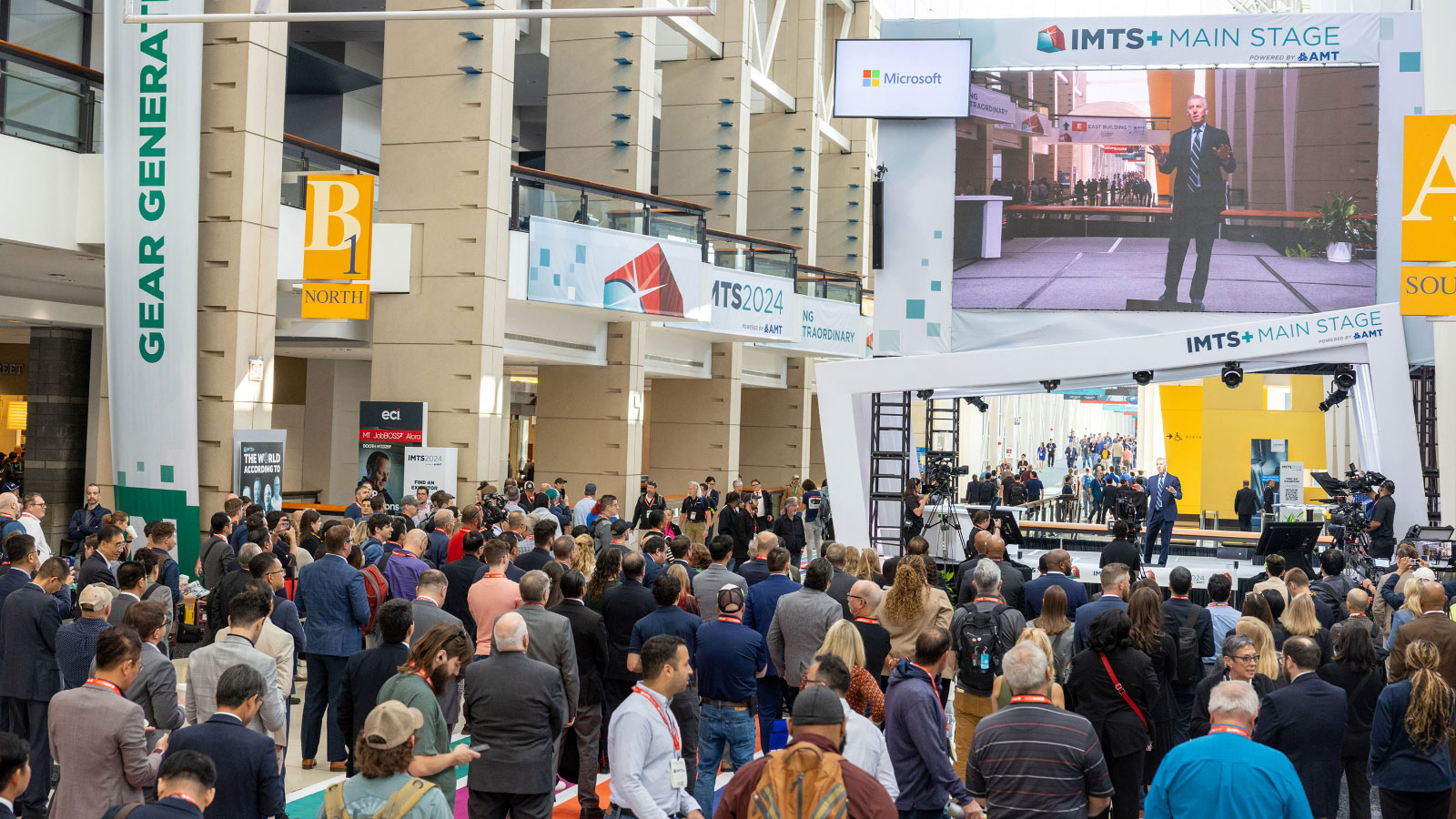
AMT President Douglas Woods presenting on the IMTS+ Main Stage in 2024. The Main Stage will return in 2026, along with many other presentation areas throughout the show floor, where visitors can learn from technology experts throughout each day.
If you’re planning to attend IMTS 2026, you will definitely want to plan ahead, especially if you're coming to Chicago to learn about the latest in manufacturing technology. While most attendees come with a solid plan for which exhibitors they want to see, it's also important to consider the many educational opportunities at the show. Because IMTS isn't just about seeing the latest models of machinery, tooling and accessories for manufacturing. It's also about knowledge. To make your life easier, the editors at AutomationMesh have done a little advance planning for you, identifying some of the key presentations happening right on the show floor that will be most interesting to those with a focus on automation, robotics, motion control and AI.
For this article, we've focused exclusively on scheduled events taking place on the show floor. These are all free to attend, with no additional admission or registration required.
Monday, September 14
Visibility, Prevention, Prediction: Proactive Manufacturing Maintenance
Monday 11:00 – 11:30
Smart Manufacturing Experience Showcase
Booth 236702 (North Hall, Level 3)
Presented by Jason Penkethman, Chief Product & Technology Officer, Lindle
Unplanned downtime can cost manufacturers up to $260,000 per hour, yet 60-70% of maintenance work today is still reactive and 3-5x times more expensive than planned work. This session breaks down three practical shifts that help manufacturing teams get ahead of failures instead of chasing them: making all maintenance work visible, strengthening preventive maintenance programs, and using real time data to spot risks before they become shutdowns. Along the way, we'll challenge common assumptions that keep teams stuck in reactive mode. Whether you manage a single plant or an entire maintenance operation, you will leave with a clear, actionable framework for reducing costs and building a more predictable, resilient operation.
The Agentic Factory: Where Human Ingenuity Meets Industrial AI
Monday 11:30 – noon
IMTS+ Main Stage
(between the North and South Halls)
Presented by Praveen Rao, Global Head of Manufacturing Industry, Google Cloud
Welcome to the era of the agentic factory. Industrial manufacturing is evolving beyond rigid, traditional automation into a dynamic, AI-driven ecosystem that connects the edge to the cloud. Today, intelligent agents are transforming operations. As frontline workers shift from manual task execution to the real-time orchestration of complex workflows, they unlock unprecedented visibility and connection from the shop floor to the top floor. In this session featuring Google Cloud and global manufacturing leaders, we will reveal how agentic AI bridges the gap between human decision-making and factory-wide execution. Join us to learn how embedding AI agents across your network connects fragmented ET, IT, and OT systems, drives continuous autonomous improvement, and scales workforce capabilities to build a resilient, future-proof industrial operation.
Purpose-Built or Generic AI? A Framework for Manufacturing Leaders
Monday 1 – 1:30
Smart Manufacturing Experience Showcase
Booth 236702 (North Hall, Level 3)
Presented by Kaimook Chirapathama, Director of Sales Engineering and Customer Success at CADDi U.S.
This session is for leaders deciding how to spend their next AI dollar: owners, presidents, and heads of engineering, operations, procurement, and digital. Most are stuck choosing between a generic copilot and a purpose-built platform, without a clear way to decide, or without any framework for what happens after that choice is made. Drawing on a decade of manufacturing consulting plus hands-on work helping companies deploy AI, including at CADDi, Kaimook will walk the room through a four-gate framework: define the real problem, match the right tool to it, confirm the organization can actually maintain what gets built, and put governance in place before it touches production. This is an open, off-the-record discussion, not a pitch. Participants will run their own AI challenges through the framework and leave with a clear next step: build, buy, or hold off, and what to do first.
From Reactive to Autonomous: How AI Agents Are Transforming Predictive Maintenance
Monday 1:30 – 2
Smart Manufacturing Experience Showcase
Booth 236702 (North Hall, Level 3)
Presented by Sundeep Ahluwalia, Chief Product Officer (CPO) at TDK SensEI
Predictive maintenance has long promised reduced downtime and cost savings, but AI agents are now accelerating its evolution from prediction to execution. This session explores how AI‑driven maintenance systems combine machine learning, real‑time asset data, and autonomous agents to move beyond alerts and dashboards into prescriptive and autonomous maintenance workflows. Attendees will learn how AI agents consume predictive insights and coordinate actions across systems such as CMMS, ERP, and historical repair logs to automatically generate work orders, optimize scheduling, manage spare parts, and continuously learn from maintenance outcomes. The presentation will highlight real‑world examples, key integration considerations, and practical steps for deployment. By the end, participants will understand how AI agents transform predictive maintenance into a closed‑loop system that actively reduces downtime, lowers costs, and shifts organizations from reactive to truly autonomous operations.
The AI Trap: Why Most Manufacturers Fail and How the Best Ones Break Free
Monday 2 – 2:30
Smart Manufacturing Experience Showcase
Booth 236702 (North Hall, Level 3)
Presented by Tyler Boykin, Vice President - AI Solutions at Orases
Most manufacturers enter the discovery phase of their AI journey with strong intentions and real investment, only to find themselves trapped in costly experiments that never reach production. The problem is not effort or resources. It is a hidden structural pattern embedded in the way organizations purchase technology, commonly known as "shiny object syndrome," where leaders chase impressive tools instead of solving the operational problems that are actively costing them money. The manufacturers who break free share one defining characteristic: they start with the business, not the tool. They surface where AI creates the largest measurable impact first, then build around it. This session gives you the strategic building blocks to move your AI journey from experimentation into production.
From Warehouse to Factory Floor: Leveraging Automated Storage and Retrieval System Intralogistics in Smart Manufacturing
Monday 3 – 4
IMTS+ Technology Hub
Booth 338164 (South Building, Level 3)
Presented by Ikram Khan, Engineering Manager at PINAXIS
Get an in-depth understanding how automation systems can create the smart factory by leveraging ASRS for kit buffering, just-in-time sequencing, and visualization. While automation has typically been sought for production in work cells, now, automating the supply of parts, tools, or dies can help create a smart environment while contributing to the bottom line. As manufacturers face increasing pressure to improve productivity, responsiveness, and lower production costs, the smart factory is no longer a concept—it’s a competitive necessity. Automated storage and retrieval systems (ASRS) play a critical role in enabling this transformation by connecting material flows, data, and automation into a single, intelligent intralogsitics backbone. This session explores how modern ASRS solutions move beyond traditional storage to become an active real time component of the manufacturing process. By tightly integrating ASRS with production lines, warehouse management systems (WMS), and enterprise platforms, manufacturers can ensure just-in-time and just-in-sequence material delivery, reduce work-in-process inventory, and eliminate manual handling errors. Real time visualization software enables updates and tracking of these processes. The result is improved throughput, higher equipment utilization, and greater process reliability across the entire plant. Attendees will gain insight into how ASRS supports smart factory initiatives such as real time visibility data-driven decision making. Hear about real-world use cases and see how manufacturers are leveraging automation to adapt to fluctuating demand and how to scale operations without disrupting production. This session will also address key considerations, including system modularity, software requirements, and future-proofing for evolving manufacturing requirements.
Tuesday, September 15
Signal & Power Integrity Challenges in Industrial Single Pair Ethernet
Tuesday, 10 – 10:30
Smart Manufacturing Experience Showcase
Booth 236702 (North Hall, Level 3)
Presented by Arnold Offner, Product Manager - Process Automation Systems at Phoenix Contact; and Palak Patel, Technical Product Manager at Telebyte
Single‑pair Ethernet (SPE), particularly IEEE 802.3cg's 10BASE‑T1L, enables long‑reach industrial connectivity with integrated power over one twisted pair. Yet this simplicity masks profound signal and power integrity (SI/PI) challenges that traditional compliance testing cannot reproduce. This session explores the physics of SI/PI degradation in SPE deployments — insertion loss at kilometer scale, PoDL ripple coupling, longitudinal imbalance, and thermal aging — and examines why field failures occur despite passing lab compliance. We demonstrate how integrated channel emulation, calibrated noise injection, and automated validation bridge the gap between theoretical compliance and real‑world reliability, including a 10BASE‑T1L device case study where an intermittent 850 m link failure was reproduced in minutes and root‑caused in hours. We close with a preview of IEEE 802.3dg (100 Mb/s SPE) and why its tighter eye margins and higher signaling rates make rigorous emulation and automated testing essential now.
Physical AI in Manufacturing: From Insight to Action
Tuesday, 10:30 – 11
IMTS+ Main Stage
(between the North and South Halls)
Presented by Dayan Rodriguez, Corporate Vice President, Manufacturing and Mobility at Microsoft Corporation
AI is moving beyond analytics and fully integrated into operations. Physical AI, systems that perceive, reason, and act in the physical environment, is beginning to reshape how manufacturers run production, quality, and supply chain. Dayan Rodriguez outlines where Physical AI is delivering measurable value today and what it will take to scale it across the enterprise. Drawing on Microsoft work embedding technical experts and enterprise grade AI engineering inside customer operations, he offers a practical view of the technology, the operating model, and the decisions leaders need to make now. For manufacturing leaders, this is a clear look at how Physical AI moves to production, and why the next decade of competitiveness depends on getting it right.
Smart Production Readiness: Building the Foundation for Industrial Automation
Tuesday 11:30 – 12:30
IMTS+ Technology Hub
Booth 338164 (South Building, Level 3)
Presented by Sven Diedrich, Head of Digital Transformation and Business Solutions at PINAXIS
The latest technology in automation, robotics, and digital solutions alone cannot guarantee a positive ROI or sustainable performance when it comes to manufacturing. This session introduces a practical “Smart Production Readiness” approach that helps plants and intralogistics operations build the right foundation of data, people skills, and IT infrastructure before implementing or scaling automation. Framed around four pillars—people, processes, data, and systems—this educational session demonstrates how to assess organizational skills and roles, stabilize end-to-end workflows, improve master and transactional data quality, and align IT/OT architecture across ERP, MES, WMS, and SCADA before implementing an automated solution or scaling for your warehouse or production intralogistics. Participants will learn how a structured readiness assessment plan translates complex shop-floor realities into clear decision support for leadership, using standardization and readiness matrices. From understanding the fundamentals of what needs to happen and in what order to implement automation correctly, to making your business case success criteria a true success, you’ll get the tools you need to implement an automated operation with positive payback.
Global Manufacturing at a Crossroads: Closing the Global Manufacturing Gap in the Age of Automation
Tuesday 1 – 1:30
Smart Manufacturing Experience Showcase
Booth 236702 (North Hall, Level 3)
Presented by Jake Hall, “The Manufacturing Millenial” and Will Healy, Director of Product & Industry Marketing at Universal Robots | MiR | Teradyne Robotics
Global manufacturing is shifting rapidly—and the gap between regions is widening. While Asia accounts for a significant share of industrial robotics adoption and manufacturing investment, North American and European manufacturers face increasing pressure to keep pace. In this candid fireside chat, industry leaders explore what it will take to remain competitive in a rapidly evolving global landscape. From capital investment trends to workforce development and policy implications, the conversation will tackle the real barriers—and opportunities—facing manufacturers today.
AI Agents on the Factory Floor: Real Stories from Real Manufacturers
Tuesday 3 – 3:30
Smart Manufacturing Experience Showcase
Booth 236702 (North Hall, Level 3)
Presented by Chris Kuntz, VP of Strategic Operations at Augmentir
AI is rapidly transforming the manufacturing workforce—and the rise of Industrial GenAI Assistants and AI Agents are leading the charge. These intelligent, agentic systems are not replacing workers, but augmenting them—helping frontline teams unlock new levels of performance, agility, and operational excellence. In this session, you’ll see how forward-thinking manufacturers are applying AI Agents on the factory floor to solve real problems in real time—from guiding operators through complex tasks, to streamlining workflows, to improving quality and efficiency. Through case studies from industry leaders including Colgate-Palmolive, Hershey, and Graphic Packaging, we’ll explore how manufacturers are using Industrial AI Agents to empower their workforce, drive measurable business impact, and set the stage for the next era of smart manufacturing.
Wednesday, September 16
You Can't Optimize What You Can't Control: The Operational Foundation Behind AI-Ready Manufacturing
Wednesday, 10:30 – 11:30
IMTS+ Technology Hub
Booth 338164 (South Building, Level 3)
Presented by Ian Cohen, SVP Global Unity Sales at Powerfleet; Shane Splittgerber, Safety Specialist at Nestlé Purina; and Denis Rousseau, Senior Safety Manager at Nestlé Purina
Most manufacturers treat safety, compliance, and efficiency as three separate problems, yet they are three outputs of the same operational system. When that system runs in disconnected pieces across the site, yard, and road, the same breakdown surfaces as risk, as compliance exposure, and as cost. The rush to apply AI to industrial operations only raises the stakes: with up to 80% of fleet data going unused, AI amplifies fragmented data rather than fixing it. You can't optimize what you can't control, and you can't trust data from processes you don't enforce. In this session, Powerfleet's Ian Cohen is joined by Nestlé Purina safety leaders Denis Rousseau and Shane Splittgerber to show what changes when control is established at the point of work. Inside a 24/7 unionized plant, Purina moved from a paper era of chasing signatures to a single, enforced standard on the floor, cutting forklift impacts by 84% with no slowdown in production, while audits that once consumed hours are now pulled up in minutes. Their story is the proof behind a larger argument: a disciplined, trustworthy floor is the exact foundation enterprise AI requires. Join us to see why the path to AI-ready operations starts where the work happens.
Solutions to Grow Your In-House Robotics Expertise
Wednesday, 11 – 11:30
Manufacturing USA Knowledge Bar
Booth 338600 (South Building, Level 3)
Presented by Suzy Teele, Chief Strategy Officer at ARM Institute
One of the biggest barriers to adopting robotics is ensuring that your team has the skills and knowledge to operate and maintain automation after the system is installed. Learn about a free resource, RoboticsCareer.org, that helps identify which competencies are needed for staff upskilling, where to gain this training, and how to find new talent to add to your team. The ARM Institute is one of 17 manufacturing innovation institutes in the Manufacturing USA network.
The Unified SPE Connector – Status and Impact for Users
Wednesday, 3:30 – 4
Smart Manufacturing Experience Showcase
Booth 236702 (North Hall, Level 3)
Presented by Thomas Keller, Product Manager Single Pair Ethernet at Rosenberger Hochfrequenztechnik Germany; Simon Seereiner,Business Development Manager Single Pair Ethernet at Weidmuller Interface Germany; and Tim Kindermann, Senior Specialist Single Pair Ethernet at Phoenix Contact
The presentation is intended to provide an overview of current standardization activities, a status of productization and a mood of acceptance for the new connector family. In addition, new markets for Single Pair Ethernet and the potential for other use cases are to be identified and evaluated.
Thursday, September 17
To PoDL or Not to PoDL: Single Pair Ethernet Power Challenge in Industrial and Automotive Applications
Thursday 1 – 1:30
Smart Manufacturing Experience Showcase
Booth 236702 (North Hall, Level 3)
Presented by Alex Gourari, Chief Technology Officer at Zemfyre; Yannik Muendler, Systems Engineer at Texas Instruments; and Thomas Mauer,System Engineer at Texas Instruments
Single Pair Ethernet (SPE) is transforming industrial connectivity by enabling long-reach communication and direct IP integration of field devices. However, power delivery remains a key challenge across many real-world deployments. This presentation reviews the scope of current IEEE standards (802.3cg, 802.3bu) and their automotive origins, highlighting both the strengths and limitations of PoDL when applied beyond its original design intent. Additionally, the presentation highlights practical design, layout, and bring-up best practices, and outlines future developments such as multidrop architecture and dynamic PLCA to further enhance flexibility and scalability in real-world deployments.